



How Do You Spell Neighbors? Correct Spelling, Meaning & Common Mistakes 🏘️✍️
Ever paused mid-sentence, mid-email, or mid-text wondering how do you spell neighbors? You’re definitely not alone it’s one of those everyday words that trips people up more often than you’d expect, largely because of a tricky silent letter combination and regional spelling differences.
In this complete guide, we’ll answer how do you spell neighbors from every angle: the correct spelling, the British vs. American difference, the word’s meaning and origin, common mistakes, memory tricks, and plenty of example sentences. By the end, you’ll never have to second-guess this word again. ✅
How Do You Spell Neighbors Correctly? 📝
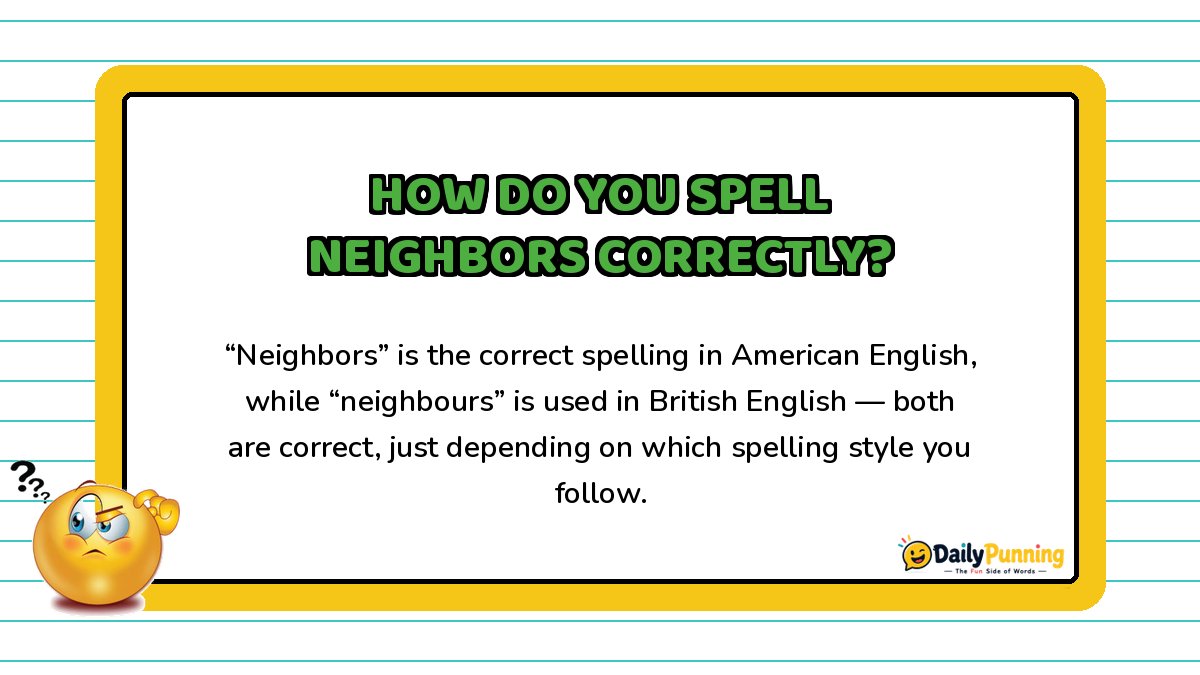
The correct American English spelling is N-E-I-G-H-B-O-R-S “neighbors.” If you’ve ever wondered how do you spell neighbors while writing a school assignment, a work email, or a quick text message, this is the spelling to use in the US, Canada (informally), and most American-style English writing. 🇺🇸
It’s worth breaking this down letter by letter, since the tricky part for most people is the “eigh” combination in the middle:
- N
- E
- I
- G
- H
- B
- O
- R
- S
Once you see it broken down this way, answering how do you spell neighbors becomes much easier to remember, since the “eigh” pattern shows up in several other common English words too.
British vs American Spelling 🌍
One of the biggest reasons people get confused about how do you spell neighbors is the difference between English variants around the world:
- American English: neighbors (no “u”)
- British/Australian/Commonwealth English: neighbours (with a “u”)
Both are completely correct it simply depends on which style of English you’re writing in. If you’re writing for a US audience, a school assignment in an American curriculum, or American-based content, stick with “neighbors.” For UK, Australian, Canadian formal writing, or other Commonwealth audiences, “neighbours” is the standard and expected spelling. 🇬🇧🇦🇺
This regional spelling difference is part of a larger pattern in English, where many words ending in “-or” in American English end in “-our” in British English think “color/colour,” “favor/favour,” and “honor/honour.” So once you understand how do you spell neighbors in both variants, you’ll start noticing this same pattern across many other words too.
What Does “Neighbors” Mean? 🏠
Beyond just how do you spell neighbors, it’s worth understanding the word’s actual meaning. A neighboris a person who lives near or next to you whether that’s next door, across the street, in the same building, or simply within the same local area or community.
The word can also be used more broadly and figuratively to describe things, places, or even countries that are located close to one another, such as “neighboring countries” or “neighboring towns.”
Understanding this meaning makes it easier to remember how do you spell neighbors correctly, since context often reinforces memory the more you use a word naturally in sentences, the more its spelling sticks.
Origin of the Word “Neighbor” 📜
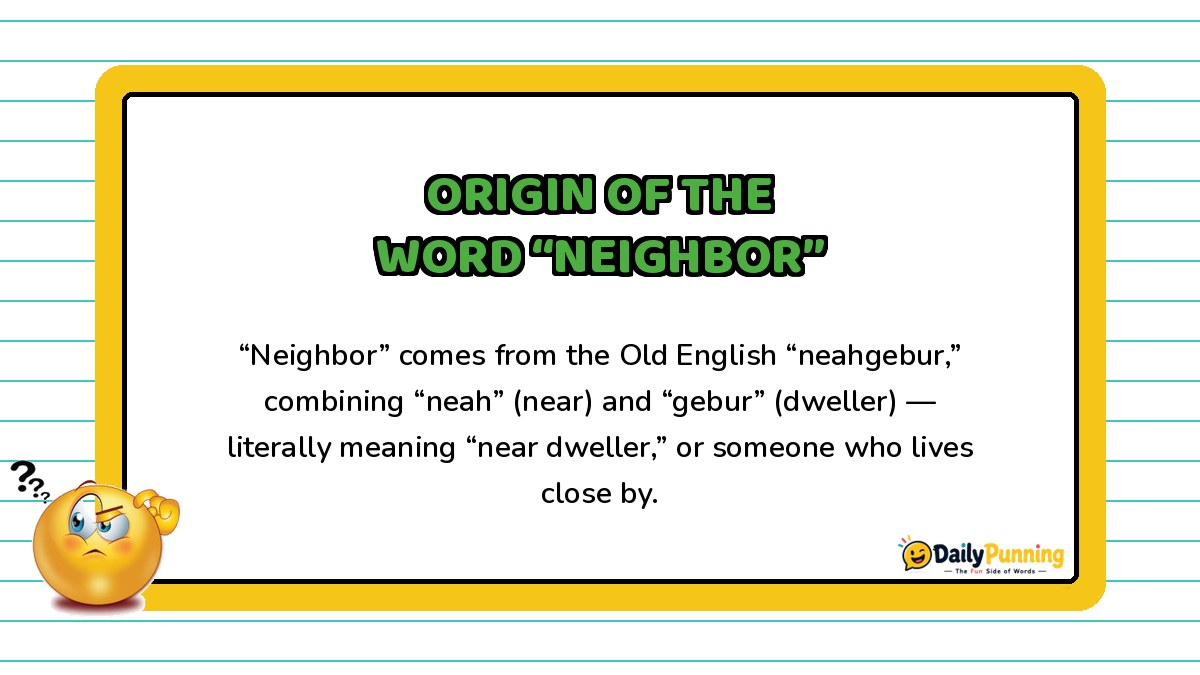
The word traces back to Old English “neahgebur,” combining “neah” (meaning “near”) and “gebur” (meaning “dweller” or “farmer”). Over centuries, as English evolved through Middle English and eventually into modern English, the spelling gradually shifted into the form we recognize today.
Understanding this history actually helps explain how do you spell neighbors the way we do now the “gh” that appears silent today was historically pronounced in Old and Middle English, which is why it still appears in the spelling even though we no longer pronounce it that way.
This is actually a common pattern in English: many words retain “silent” letters from earlier stages of the language, even after pronunciation has changed. Words like “night,” “light,” “though,” and “neighbor” all share this same historical “gh” pattern, which is part of why so many people ask how do you spell neighbors in the first place the spelling doesn’t match how the word sounds when spoken.
Common Misspellings to Avoid ⚠️
When people search how do you spell neighbors online, it’s often because of one of these common mistakes:
- “Nieghbors” ❌ – a classic letter-swap mistake, putting the “i” before the “e” incorrectly
- “Neighbours” ❌ – correct in British English, but incorrect if American spelling is required
- “Neighbers” ❌ – dropping the “igh” entirely
- “Naybors” ❌ – a phonetic misspelling based on how the word sounds rather than how it’s written
- “Neighbours” vs “Neighbors” confusion in mixed writing – switching between British and American spelling within the same document
Remembering the correct pattern N-E-I-G-H-B-O-R-S helps avoid all of these common slip-ups, and knowing exactly how do you spell neighbors prevents embarrassing typos in emails, essays, or social posts.
Easy Tricks to Remember the Spelling 💡
If you still find yourself unsure about how do you spell neighbors, here are a few memory tricks that can help:
- Break it into parts: “neigh” (like the sound a horse makes) + “bor” + “s”
- Remember the silent “gh” – it’s silent but still there, just like in “night,” “light,” or “though”
- Practice writing it in full sentences a few times: “My neighbors are very friendly.”
- Use mnemonic devices – some people remember it as “Neigh” (horse sound) + “Bors” (like a name), which makes the spelling feel more memorable and less abstract
- Compare it to similar words – recognizing that “eigh” shows up in “weigh,” “sleigh,” and “eight” can help reinforce the pattern
Using tricks like these makes answering how do you spell neighbors almost automatic after a bit of practice.
Example Sentences Using “Neighbors” 📚
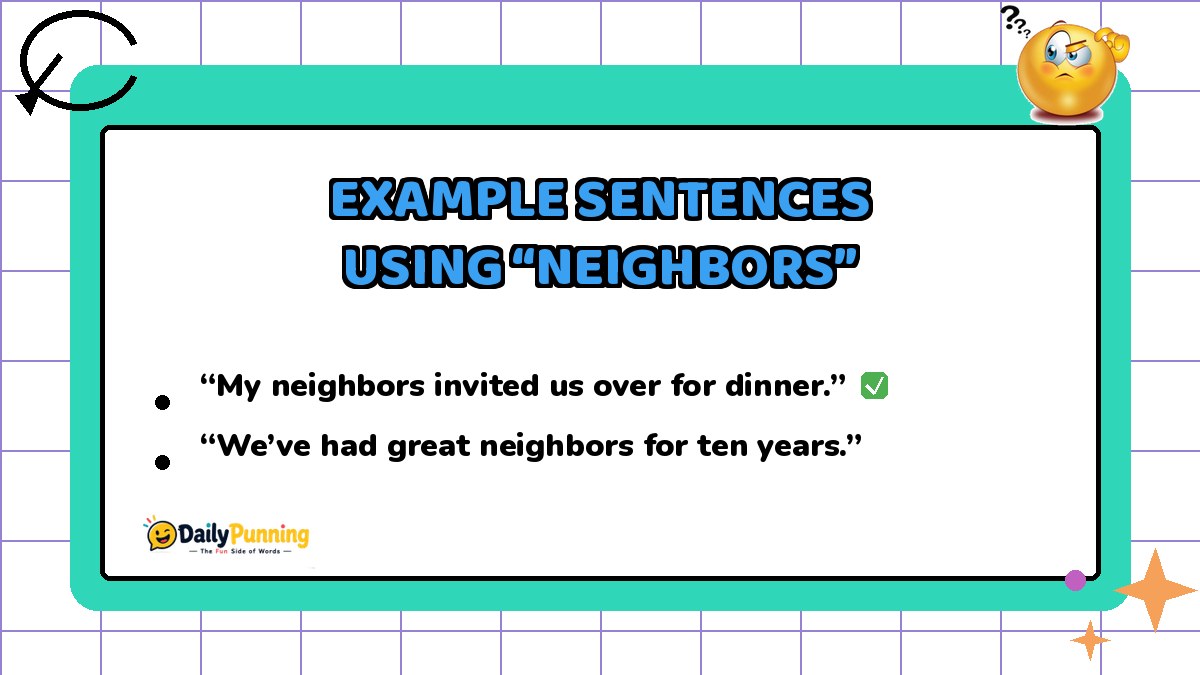
Seeing the word used naturally in context can also help cement the correct spelling in your memory. Here are several examples:
- “Our neighbors invited us over for dinner last night.” 🍽️
- “The neighbors next door just moved in a few weeks ago.” 📦
- “Good neighbors make a community feel like home.” 🏘️
- “We share a fence with our neighbors.” 🌳
- “The neighbors organized a block party for the whole street.” 🎉
- “I’ve known my neighbors for over ten years now.” ⏳
- “Our neighbors have a really friendly dog.” 🐶
- “The new neighbors seem really nice so far.” 😊
Each of these examples reinforces both the meaning and the correct spelling, making it easier to recall how do you spell neighbors the next time you need to write it.
Why This Word Is Commonly Searched Online 🔍
It might seem surprising that so many people search how do you spell neighbors online, but it makes sense once you consider a few factors:
- The silent “gh” doesn’t match typical phonetic spelling patterns in English
- The word has two completely valid spellings depending on region (American vs. British)
- Many people learn the word by ear before ever seeing it written down, leading to phonetic guesses
- Autocorrect and spellcheck tools sometimes flag one version as incorrect depending on language settings, adding to the confusion
All of these factors combined explain why how do you spell neighbors remains one of the more frequently searched spelling questions in English, despite being a very common, everyday word.
FAQs ❓
How do you spell neighbors in American English?
N-E-I-G-H-B-O-R-S no “u” before the “rs.”
How do you spell neighbors in British English?
“Neighbours” with a “u” before the “rs,” following standard British spelling conventions.
Is “neighbors” singular or plural?
“Neighbor” (or “neighbour”) is singular; “neighbors” (or “neighbours”) is the plural form.
What’s a common misspelling of neighbors?
“Nieghbors” is one of the most frequent mistakes, caused by swapping the “i” and “e.”
Does the spelling change the meaning of the word?
No “neighbors” and “neighbours” mean exactly the same thing; only the regional spelling convention differs between American and British English.
Why is there a silent “gh” in neighbors?
It’s a historical remnant from Old and Middle English, where that sound was once pronounced but has since become silent in modern pronunciation.
Which spelling should I use for school or work?
It depends on the expected style guide use “neighbors” for American English contexts and “neighbours” for British, Australian, or Canadian formal writing.
Conclusion 🏁
So, how do you spell neighbors? Simply put: N-E-I-G-H-B-O-R-S in American English, or “neighbours” in British and Commonwealth English. Both spellings are completely correct depending on your audience and regional writing style.
Now that you understand the correct spelling, the word’s meaning and origin, common mistakes to avoid, and a few simple memory tricks, you’ll be able to confidently answer how do you spell neighbors every single time, without ever second-guessing yourself again. ✅🏘️


