



Marinate or Marinade? The Real Difference Explained (With Examples) 🍗🧄
If you’ve ever paused while writing a recipe or a grocery list and wondered marinate or marinade which one is correct here? You’re definitely not alone. These two words look and sound so similar that even experienced home cooks and writers mix them up constantly.
In this complete guide, we’ll settle the marinate or marinade debate once and for all, covering the exact meaning of each word, their grammatical roles, origin, common mistakes, memory tricks, and plenty of real examples so you’ll never second-guess yourself again. 🔍
Marinate or Marinade: What’s the Actual Difference? 📝
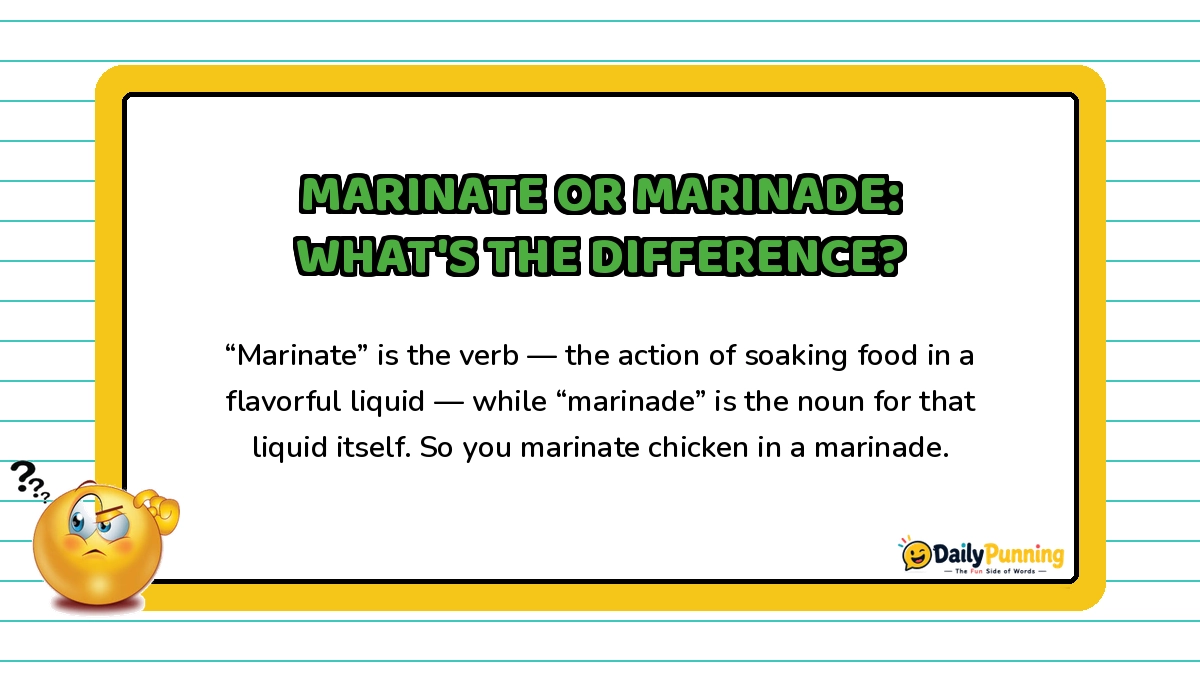
The short answer to marinate or marinade is this: they’re two different parts of speech that describe two related but distinct things.
- Marinade is a noun it refers to the flavorful liquid mixture (usually oil, an acid like vinegar or citrus juice, and herbs or spices) that food is soaked in before cooking.
- Marinate is a verb it describes the action of soaking food in that marinade to add flavor and tenderness.
So when people ask marinate or marinade, the real question is simply: are you talking about the sauce itself, or the act of soaking food in it? Once you separate the noun from the verb, the confusion mostly disappears. ✅
Marinade: The Noun 🧂
When exploring marinate or marinade, start with the noun form. A marinade is the actual mixture typically combining an acid (like lemon juice, vinegar, or wine), an oil, and various herbs, spices, garlic, or other flavorings. This mixture is prepared first, before any food ever touches it.
Example sentences using “marinade” correctly:
- “This chicken marinade is packed with garlic and lime.”
- “She whisked together a quick soy-ginger marinade.”
- “The steak sat in the marinade overnight.”
In every one of these examples, “marinade” refers to the actual liquid mixture the thing you make in a bowl before you ever start soaking anything in it.
Marinate: The Verb 🍖
The other half of the marinate or marinade question is the verb form. “Marinate” describes the action that happens when food sits in a marinade and absorbs its flavor over time.
Example sentences using “marinate” correctly:
- “Marinate the chicken for at least two hours before grilling.”
- “Let the tofu marinate overnight in the refrigerator.”
- “The fish was marinated in a blend of soy sauce and ginger.”
Notice that in each case, “marinate” is describing the process of actual soaking, rather than the sauce itself. This distinction is the entire key to solving the marinate or marinade puzzle whenever it comes up.
A Simple Trick to Remember the Difference 💡
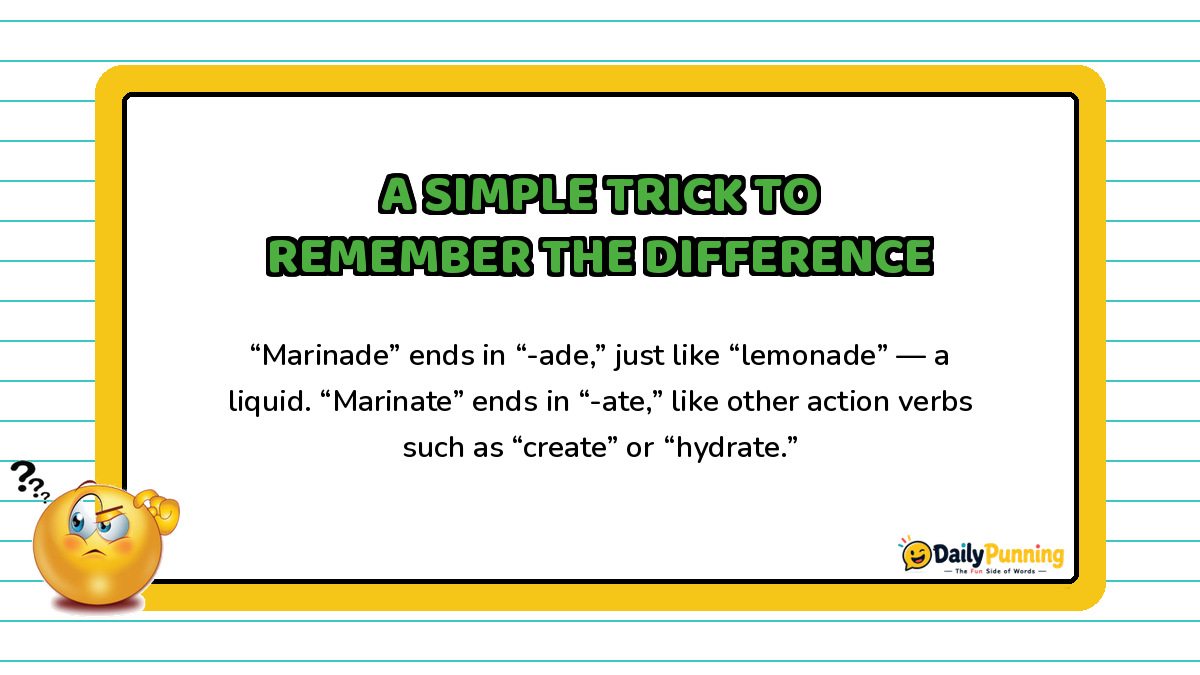
If you still find yourself stuck on marinate or marinade, here’s an easy memory trick: think of the word “lemonade.” Just like lemonade is a liquid you drink, marinade is a liquid you soak food in both end in “-ade,” and both refer to a liquid substance.
Meanwhile, “marinate” ends in “-ate,” just like other action verbs such as “hydrate,” “rotate,” or “activate” all describing something being done.
Using this simple pattern makes it much easier to instantly answer marinate or marinade any time you’re unsure while writing a recipe, blog post, or shopping list.
Why People Constantly Confuse Marinate or Marinade ⚠️
The marinate or marinade mix-up is incredibly common, and it’s not just careless writing; there are real linguistic reasons behind it:
- The words sound nearly identical when spoken quickly, differing only in their final syllable.
- Many recipes use both words in the same paragraph, making it easy to slip and use the wrong one.
- Because the confusion has become so widespread, some dictionaries have started listing “marinade” as an acceptable variant of the verb “marinate,” which only adds to the uncertainty.
- Non-native English speakers, and even many native speakers, often rely on how a word sounds rather than its grammatical role, which blurs the line between marinate or marinade even further.
Even professional food writers and recipe developers occasionally slip up on marinate or marinade, which shows just how easy this mistake is to make.
Origin of Marinade and Marinate 📜
Understanding the history behind marinate or marinade can also help clarify why the words are used the way they are today. Both terms trace back to the French word “mariner,” meaning “to pickle in brine,” which itself comes from the Latin word “mare,” meaning “sea.”
Historically, marinades were used not just for flavor but as a method of food preservation, similar to brining or pickling, since soaking food in an acidic, salty liquid helped prevent spoilage before refrigeration existed.
Over time, as marination became more about enhancing flavor and tenderness rather than long-term preservation, the noun “marinade” and the verb “marinate” developed side by side in English, eventually leading to the modern marinate or marinade confusion we still see today.
Common Mistakes to Avoid ⚠️
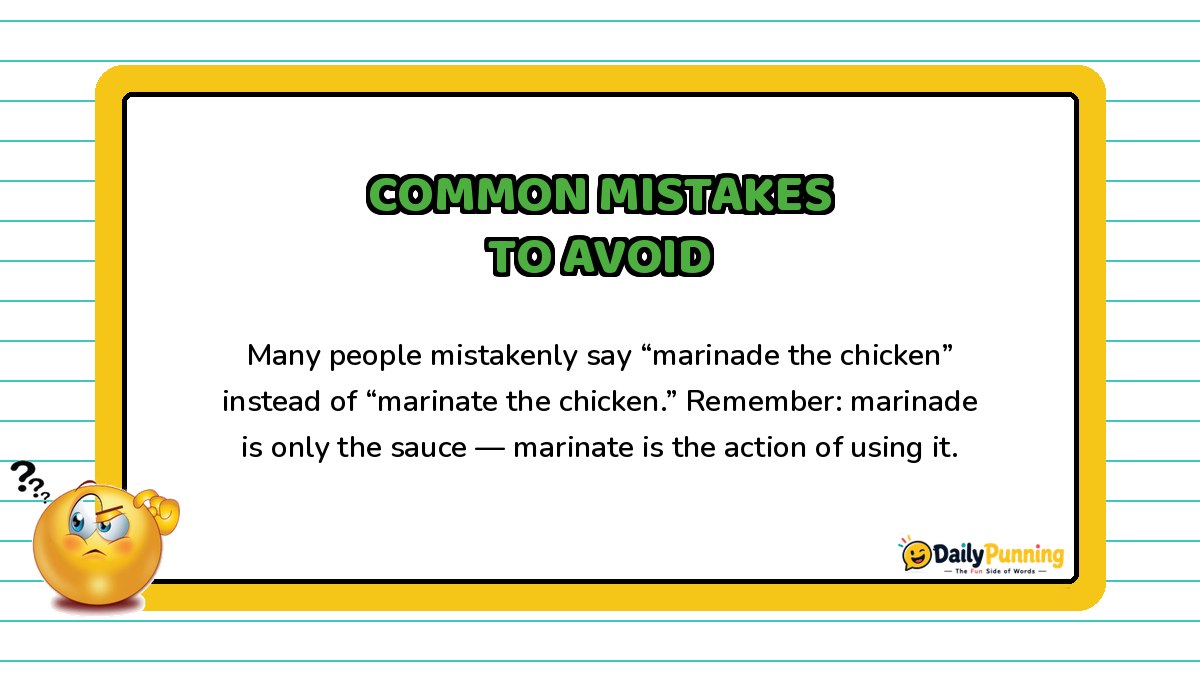
When it comes to marinate or marinade, here are the most frequent mistakes people make:
- Using “marinade” as a verb for example, saying “marinade the chicken overnight” instead of the grammatically correct “marinate the chicken overnight.”
- Using “marinate” as a noun for example, saying “pour the marinate over the meat” instead of “pour the marinade over the meat.”
- Mixing both forms in the same sentence or recipe, which creates inconsistency and confusion for readers.
- Assuming they’re fully interchangeable while common usage has blurred the line somewhat, using each word in its correct grammatical role still reflects more polished, professional writing.
Avoiding these mistakes is the easiest way to settle any marinate or marinade debate the moment it comes up.
Marinate or Marinade in Recipes: Real Examples 📚
To fully understand marinate or marinade in practical use, here are several complete recipe-style examples:
- “Whisk together the olive oil, lemon juice, garlic, and herbs to make the marinade.”
- “Marinate the chicken breasts in the mixture for at least 30 minutes.”
- “Pour the marinade over the vegetables and toss to coat evenly.”
- “Cover the bowl and let the shrimp marinate in the refrigerator for one hour.”
- “This teriyaki marinade works beautifully on salmon.”
- “Marinate the tofu overnight for maximum flavor absorption.”
- “The steak marinade includes soy sauce, brown sugar, and fresh ginger.”
- “Let the pork marinate for up to 24 hours for the most tender result.”
Each of these examples uses “marinade” and “marinate” correctly according to their grammatical roles the noun describing the mixture, and the verb describing the soaking process.
Does It Really Matter Which One You Use? 🤔
Given how widespread the marinate or marinade confusion has become, you might wonder whether it actually matters in casual conversation or informal writing. The honest answer is: it depends on your audience. In casual conversation, most people will understand what you mean either way, and many dictionaries now acknowledge “marinade” as an accepted, though less traditional, verb form.
However, in professional writing, published recipes, cookbooks, food blogs, or any content where accuracy and polish matter, correctly distinguishing marinate or marinade shows attention to detail and strengthens your credibility as a writer. If you’re creating content for a food blog, restaurant menu, or cookbook, using each word correctly is a simple way to elevate the quality of your writing.
Marination: The Bigger Picture 🌍
Beyond just settling marinate or marinade as individual words, it helps to understand marination as a broader culinary technique. Marinating typically involves an acid, an oil, and flavorings, and serves two main purposes: enhancing flavor and helping tenderize tougher cuts of meat.
The acid in a marinade works by breaking down proteins on the surface of the food, allowing flavors to penetrate more deeply, though contrary to popular belief, most marinades primarily affect the surface rather than deeply penetrating the interior of thick cuts of meat.
Marination techniques appear across many global cuisines, from teriyaki in Japanese cooking to adobo in Mexican cuisine to various citrus-based marinades in Latin American ceviche.
Recognizing this wider culinary context makes the marinate or marinade distinction feel less like a random grammar rule and more like a meaningful part of understanding how flavor and cooking actually work.
How Professional Chefs Approach This Distinction 👨🍳
In professional kitchens, precision in language often mirrors precision in technique. Chefs and culinary instructors are typically trained to use each word in its correct grammatical role, since clear communication in a recipe or kitchen instruction can directly affect how a dish turns out.
A recipe that says “marinate the salmon for 20 minutes” gives a clear action with a clear time frame, while a recipe describing “the marinade” as a separate component helps cooks understand exactly what they’re preparing versus what they’re doing with it.
This same precision carries over into cookbooks, culinary school textbooks, and professional food media, where editors and copyeditors are often specifically trained to catch and correct this exact grammatical mix-up. For anyone writing recipes professionally, getting this right isn’t just a small grammar detail it reflects the same attention to detail that goes into the cooking itself.
Regional and Cultural Variations in Marination 🌏
Marination techniques vary widely across different culinary traditions, even though the core grammar distinction remains the same regardless of cuisine. In Japanese cooking, soy-based marinades like teriyaki are used to add both sweetness and umami depth.
In Mexican cuisine, citrus and chili-based marinades form the foundation of dishes like carne asada. In Mediterranean cooking, olive oil, lemon, and fresh herbs create bright, tangy marinades often used for grilled meats and vegetables.
Despite these cultural differences in ingredients and technique, the underlying grammar remains consistent everywhere in English-language writing: the mixture itself is always the marinade, and the process of soaking food in it is always described as letting something marinate.
Recognizing this consistency can make it easier to write clearly about food from any culinary tradition without ever second-guessing your word choice again.
FAQs About Marinate or Marinade ❓
Is marinade a noun or a verb?
Marinade is traditionally a noun, referring to the flavorful liquid mixture used to soak food.
Is marinate a noun or a verb?
Marinate is a verb, describing the act of soaking food in a marinade.
Can “marinade” ever be used as a verb?
Some dictionaries now accept it due to widespread common usage, but “marinate” remains the traditionally correct verb form.
What’s an easy way to remember whether to use “marinate” or “marinade”?
Think of “lemonade” for marinade (a liquid), and “-ate” verbs like “hydrate” for marinate (an action).
Does it really matter which one I use in casual speech?
Not much in casual conversation, but using each word correctly matters more in professional or published writing.
Where do marinade and marinate come from?
Both trace back to the French word “mariner” and the Latin word “mare,” meaning “sea,” tied to historical brining and pickling traditions.
What’s a simple example of both words used correctly?
“Whisk together the marinade, then marinate the chicken for two hours before cooking.”
Conclusion 🏁
So, next time you’re stuck deciding between marinate or marinade, remember the simple rule: marinade is the noun the flavorful liquid you prepare, while marinate is the verb, the action of soaking food in that liquid.
Understanding this distinction, along with its origin and the common mistakes people make, will help you write more accurately and confidently, whether you’re following a recipe, writing a food blog, or simply explaining your cooking process to a friend.
Now that you know exactly how to answer marinate or marinade, you’ll never mix up these two kitchen essentials again. 🍗✅


