



What Does IDM Mean in Chat? Definition, Examples, and Replies
Have you ever received a text message containing “IDM” and wondered what the person was trying to say? 🤔 You’re not alone! Internet slang can make everyday conversations confusing, especially when someone uses abbreviations without explaining them.
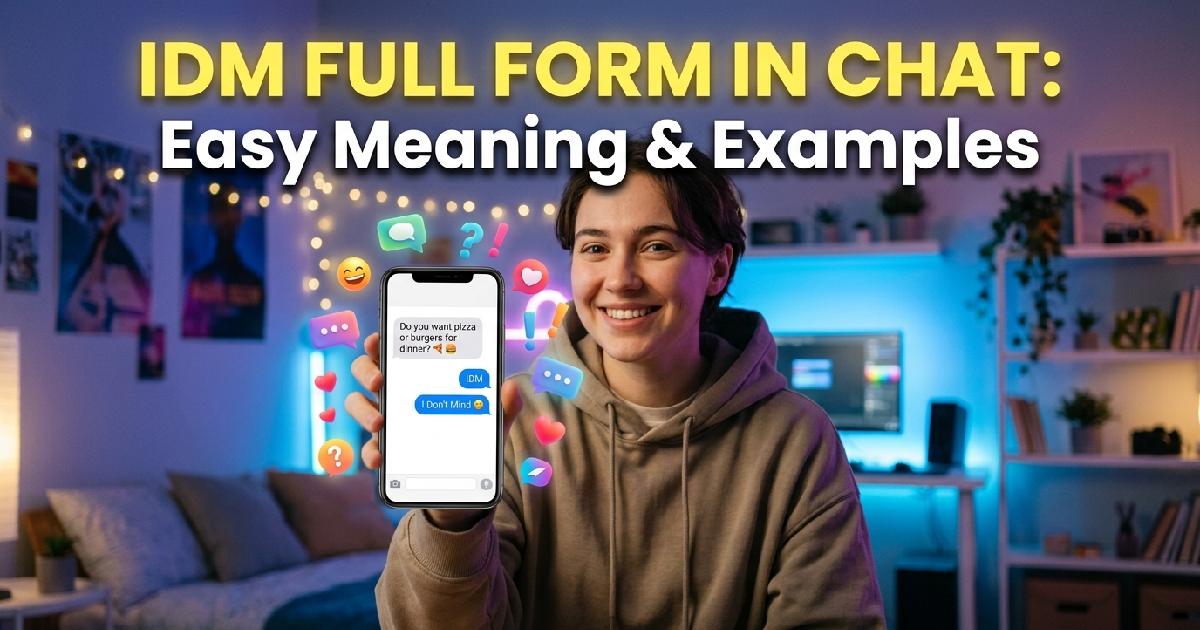
The IDM full form in chat is usually “I Don’t Mind.” People use it to express that they are comfortable with a suggestion, have no objection to a particular choice, or are happy to go along with someone else’s plans. It’s a quick, casual way to show flexibility without typing a complete sentence.
For example, if your friend asks, “Should we watch a comedy or an action movie?” you could reply, “IDM, you choose!” This means you’re happy with either option.
However, context matters. In some conversations, IDM can have other meanings, so it’s important to look at the surrounding message before deciding what someone means.
In this guide, you’ll discover what IDM means in texting, how people use it in everyday conversations, real-life chat examples, alternative meanings, and simple ways to reply when someone sends you this abbreviation.
💬 What Is the Full Form of IDM in Chat?

In everyday texting and online conversations, IDM stands for “I Don’t Mind.” It is an informal abbreviation commonly used when someone wants to communicate that they don’t have a problem with a suggestion, decision, or situation.
Instead of typing “I don’t mind,” people can simply write “IDM.” This saves time and keeps conversations short, especially on messaging platforms such as WhatsApp, Instagram, Snapchat, Discord, and other social media apps.
Here is a simple example:
Friend: Do you want pizza or burgers for dinner? 🍕🍔
You: IDM, anything is fine!
In this conversation, IDM tells your friend that you’re comfortable with either choice. You’re leaving the final decision up to them.
The abbreviation can also communicate agreement, flexibility, or a lack of preference. However, it doesn’t always mean that you actively like something. Sometimes, it simply means that you have no objection.
For instance, if someone asks whether they can sit beside you, replying “IDM” means you’re okay with it. It doesn’t necessarily mean that you particularly wanted them to sit there.
IDM is generally casual, so it works best in friendly conversations rather than formal emails, professional reports, or official communication.
📱 What Does IDM Mean in Texting?
When someone sends you IDM in a text message, they usually mean that they are okay with whatever you’re suggesting. The exact meaning depends on the question, situation, and tone of the conversation.
Here are some common ways people use IDM.
1. Showing That You Have No Preference
People often use IDM when they don’t have a strong opinion about a choice.
Example:
Friend: Should we meet at 5 PM or 6 PM?
You: IDM, whichever works for you. 👍
Your response means that either time is acceptable. You’re allowing your friend to choose the more convenient option.
2. Agreeing to a Suggestion
IDM can also show that you’re comfortable with another person’s idea.
Example:
Friend: Can we order Chinese food tonight? 🥡
You: IDM!
Here, you’re saying that Chinese food is fine with you.
3. Giving Someone Permission
Sometimes, IDM means that you don’t object to someone doing something.
Example:
Friend: Do you mind if I borrow your headphones?
You: IDM, just bring them back tomorrow. 🎧
In this situation, you’re communicating that borrowing the headphones is okay.
4. Keeping a Conversation Casual
Texting abbreviations make everyday conversations quicker. IDM allows someone to express a simple thought without writing a long response.
Example:
Friend: I’ll send you the notes later.
You: IDM, thanks! 😊
The reply suggests that you’re comfortable with the arrangement.
Remember that IDM doesn’t automatically mean enthusiastic agreement. If someone wants to know whether you’re genuinely excited about an idea, a clearer response such as “Yes, that sounds great!” may communicate more.
✍️ How to Use IDM in a Sentence

Using IDM is easy once you understand the meaning. In most cases, you can replace the full phrase “I don’t mind” with the abbreviation when chatting informally.
Here are several natural ways to use it:
- “IDM what we watch tonight.”
- “IDM if you want to invite your friends.”
- “IDM, you can choose the restaurant.”
- “IDM waiting a few more minutes.”
- “IDM either way, so it’s up to you.”
These examples show how IDM can fit different situations. However, the wording around it matters. Some sentences sound more natural when you use the full phrase instead, particularly when you are explaining a complicated preference or making a request.
For example, “I don’t mind waiting a few more minutes” sounds natural in everyday English. In a very casual text, someone might shorten it to “IDM waiting a few more minutes.”
You can also use IDM as a standalone reply when the context is clear.
Person: Is it okay if I call you later? 📞
You: IDM.
This short response communicates that you have no objection to the call.
One important tip: if you genuinely dislike an option, don’t use IDM just to avoid expressing your opinion. Clear communication helps prevent misunderstandings.
😂 IDM Chat Examples: Real Conversations
The easiest way to understand internet slang is to see how people use it in conversations. The following original examples illustrate common texting situations where IDM sounds natural.
Example 1: Choosing a Movie
Alex: What movie should we watch tonight? 🎬
Sam: IDM, you pick.
Alex: Okay, horror movie it is!
Sam: Wait, I said I don’t mind, not that I won’t scream for three hours! 😱
In this example, Sam initially leaves the decision to Alex and then adds a playful joke. IDM communicates flexibility rather than a specific preference.
Example 2: Deciding Where to Eat
Friend 1: Pizza, burgers, or tacos? 🌮
Friend 2: IDM, I’m hungry enough to eat the menu.
Friend 1: Perfect. We’re ordering everything!
Friend 2: My wallet just left the group chat. 💸
This conversation shows how IDM can make a casual decision easier while leaving room for humor.
Example 3: Changing Plans
Mia: Can we meet at 7 instead of 6?
Emma: IDM, 7 works for me.
Mia: Thanks for being flexible!
Emma: No problem. It gives me another hour to pretend I’m productive. 😂
Here, IDM indicates that the change is acceptable.
Example 4: Borrowing Something
Chris: Do you mind if I borrow your charger? 🔌
Jordan: IDM, just don’t forget to return it.
Chris: Of course!
Jordan: You said that last time, and my charger went on a two-week vacation. 🏖️
This example shows how IDM can express permission while still allowing someone to mention a condition.
Example 5: Choosing a Place to Study
Student 1: Should we study at the library or at my house? 📚
Student 2: IDM, wherever there’s Wi-Fi.
Student 1: The library, then.
Student 2: Great. My biggest academic skill is finding internet access. 😂
IDM makes the choice simple because the speaker doesn’t strongly prefer either location.
Example 6: Picking a Time to Call
Friend: Can I call you after dinner?
You: IDM, call whenever you’re free. 😊
This response shows that you’re comfortable with the proposed arrangement.
Example 7: Selecting a Game
Friend 1: Do you want to play football or basketball? ⚽🏀
Friend 2: IDM, let’s decide with a coin toss.
Friend 1: Heads for football, tails for basketball.
Friend 2: And if it lands on its edge, we go home and become professional coin collectors. 🤣
The abbreviation communicates that either game is acceptable.
Example 8: Making Weekend Plans
Friend 1: Are we going shopping on Saturday or Sunday? 🛍️
Friend 2: IDM, both days are fine.
Friend 1: Your bank account might disagree.
Friend 2: My bank account doesn’t get invited to weekend plans. 💳😂
This conversation illustrates how IDM can communicate flexibility in a friendly exchange.
📲 What Does IDM Mean on WhatsApp, Instagram, and Snapchat?

The meaning of IDM generally stays the same across popular messaging and social media platforms: I Don’t Mind. However, the way people use it can vary depending on the conversation.
IDM on WhatsApp
WhatsApp users may send IDM when discussing plans, asking for permission, or deciding what to do.
Example:
Friend: Should I add you to the group?
You: IDM, go ahead. 👍
The response means that you don’t object to being added.
IDM on Instagram
On Instagram, IDM may appear in direct messages when people discuss meeting up, sharing content, or making plans.
Example:
Person A: Want to check out this café tomorrow? ☕
Person B: IDM, looks good!
The person is comfortable with the suggestion.
IDM on Snapchat
Snapchat conversations are often quick and informal, making abbreviations convenient.
Example:
Friend: Streaks now or later? 🔥
You: IDM, whenever.
Here, the sender indicates that either time works.
IDM in Discord and Online Gaming
In gaming communities and Discord chats, people may use IDM when deciding which game to play, choosing a server, or agreeing on a team activity.
Example:
Player 1: Ranked match or casual game? 🎮
Player 2: IDM, your call.
The player is happy to let someone else decide.
Across all these platforms, context remains important. If IDM appears in a technical discussion, a work conversation, or a specialized community, it may stand for something else.
🔎 Other Possible Meanings of IDM
Although “I Don’t Mind” is a common meaning of IDM in casual texting, the abbreviation can have other meanings depending on the subject being discussed.
Here are some possibilities you may encounter.
1. Intelligent Dance Music
In music discussions, IDM can stand for Intelligent Dance Music, a term associated with experimental electronic music. People may use the abbreviation when discussing artists, albums, music production, or electronic music genres. 🎵
For example:
“I’m exploring IDM artists and experimental electronic albums.”
In this context, the person is discussing music rather than saying that they have no objection.
2. Identity Management
In technology and cybersecurity, IDM can refer to identity management. This involves managing digital identities and controlling access to systems, applications, and information. 🔐
For example:
“Our company is improving its IDM processes.”
This is a technical use of the abbreviation and is unrelated to casual texting.
3. Internet Download Manager
IDM is also widely recognized as an abbreviation for Internet Download Manager, a download-management application used on Windows computers. 💻
For example:
“My IDM download stopped halfway through.”
Here, the speaker is talking about downloading files rather than expressing a preference.
4. Other Industry-Specific Uses
In business, education, and specialized technical fields, IDM may be used for other terms. The intended meaning depends on the organization’s terminology and the subject of the conversation.
If someone sends “IDM” without any explanation, look at the messages before and after it. A discussion about weekend plans likely points toward “I Don’t Mind,” while a conversation about download speeds may refer to Internet Download Manager.
💬 How to Reply When Someone Says IDM

Your response to IDM depends on what the other person means and what you want to communicate. If someone says IDM while discussing plans, you can usually continue the conversation by making a decision or asking a follow-up question.
Here are some natural responses for different situations.
When Someone Has No Preference
If the other person leaves the decision to you, choose an option and confirm it.
Them: Where should we meet?
You: Let’s meet at the coffee shop near the station. ☕
Other possible replies include:
- “Okay, let’s go with option one.”
- “Great, I’ll decide then.”
- “Perfect, I’ll make the arrangements.”
When Someone Agrees With Your Suggestion
If IDM indicates that the person is comfortable with your idea, acknowledge the response and move forward.
Them: IDM, we can watch that movie.
You: Awesome, I’ll book the tickets! 🍿
You could also say:
- “Great, sounds good!”
- “Thanks for being flexible.”
- “Perfect, that’s settled.”
When You Need a Clearer Answer
Sometimes, IDM can sound neutral rather than enthusiastic. If the decision matters, ask whether the person genuinely likes the option.
Them: IDM.
You: Are you actually okay with it, or would you prefer something else?
This gives the other person an opportunity to express a real preference.
When You Want to Keep Things Funny
If you’re chatting with a close friend, a playful response can keep the conversation entertaining. 😜
Them: IDM, choose whatever you want.
You: Dangerous words. I’m choosing a seven-hour documentary about penguins. 🐧
Other playful responses include:
- “Your lack of preference has given me unlimited power.”
- “Excellent. I’ll let the universe decide.”
- “Perfect, my questionable decision-making skills are up next.”
- “Great! Don’t blame me if we end up eating cereal for dinner.” 🥣
Use humorous replies when the tone of the conversation makes them appropriate. A joke may be entertaining among friends but confusing in a serious discussion.
🤔 IDM vs. IDK: What’s the Difference?
IDM and IDK look similar, but they communicate different things.
IDM means “I Don’t Mind.” It generally indicates that someone has no objection or doesn’t strongly prefer one option over another.
IDK means “I Don’t Know.” It communicates uncertainty or a lack of information.
Consider these examples:
Question: What should we eat tonight? 🍕
Reply 1: IDM, you choose.
This means the person is comfortable with your choice.
Reply 2: IDK, what do you feel like eating?
This means the person doesn’t know what they want to eat.
The difference is important because IDM often allows a conversation to move forward, while IDK may indicate that the person needs more information or help making a decision.
Here’s another comparison:
- IDM: I’m okay with either option. 👍
- IDK: I’m not sure what the answer or choice should be. 🤷
Understanding the difference helps you avoid confusing flexibility with uncertainty.
😎 IDM vs. IDC: What’s the Difference?
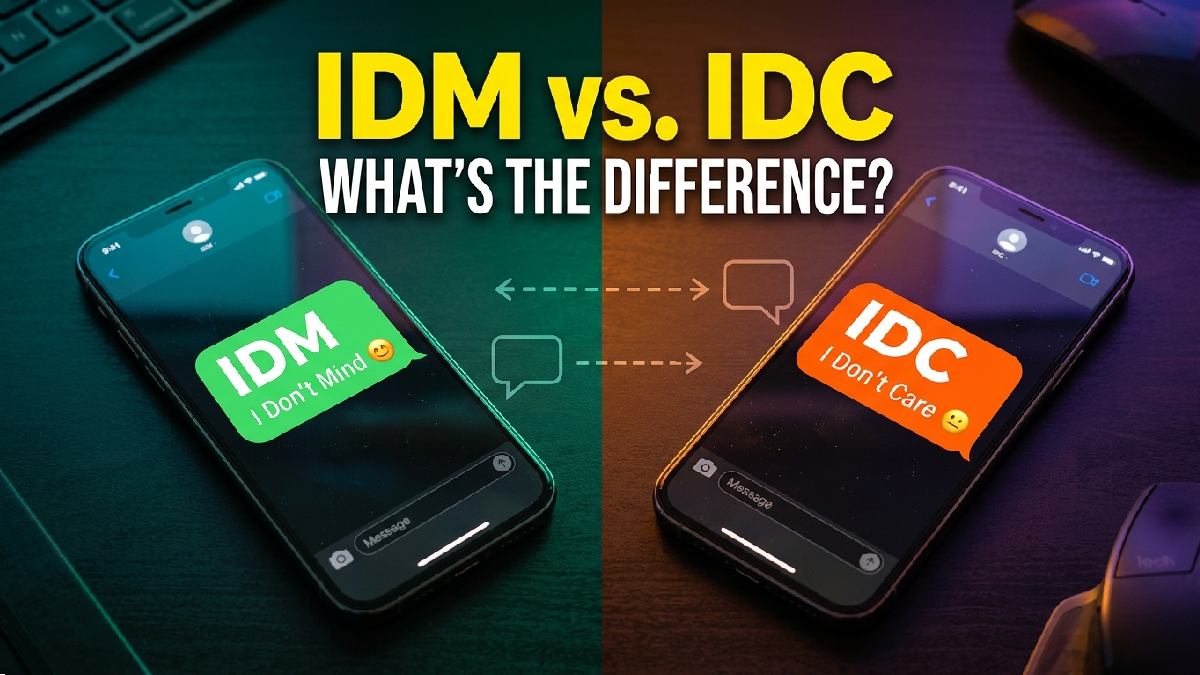
IDM and IDC are also different, even though they may appear in similar conversations.
IDM means “I Don’t Mind.” It usually expresses acceptance or a lack of objection.
IDC means “I Don’t Care.” Depending on the tone, it can communicate indifference, disinterest, or frustration.
For example:
Friend: Should we go to the park or the beach? 🏖️
Reply 1: IDM, either sounds good.
This suggests that both options are acceptable.
Reply 2: IDC, do whatever you want.
This could sound dismissive or annoyed, depending on the relationship and context.
IDC isn’t always intended to be rude, but it can come across as less considerate than IDM. If you want to show flexibility without sounding uninterested, IDM is often the more suitable choice.
For clear communication, remember that small differences in abbreviations can change the tone of a message.
😊 Is IDM Rude or Polite?
IDM is generally neutral and informal. It isn’t inherently rude, and people often use it to show that they’re easygoing about a decision.
However, tone and context can affect how the message is received.
For example, if a friend asks, “Do you mind if we meet a little later?” and you reply “IDM,” the response will usually be understood as acceptance.
On the other hand, if someone asks an important question about your preferences and you repeatedly respond with only “IDM,” they might think you’re uninterested or unwilling to participate in the decision.
To sound warmer, you can add a few words:
- “IDM, whatever works best for you.”
- “IDM! Both options sound good.”
- “I don’t mind at all. Thanks for asking.”
- “IDM, but I’d slightly prefer the earlier time.”
The final example is especially useful when you’re generally flexible but still have a preference.
In professional conversations, it’s usually better to write the complete phrase or give a direct answer. For example, “Either time works for me” is clearer in a work email than simply writing IDM.
📝 When Should You Use IDM?

IDM is most useful when you want to communicate flexibility without writing a lengthy response.
You can use it when:
- A friend asks which movie you want to watch. 🎬
- Someone wants to know whether you mind a small change in plans.
- You’re happy to let another person choose a restaurant.
- A group is deciding between two equally acceptable options.
- You’re chatting informally and want to keep your messages short.
However, there are situations where a more specific answer is better.
If someone asks about an important decision, your personal boundaries, or something that requires clear consent, don’t rely on a vague abbreviation. Explain what you are comfortable with and mention any conditions that matter.
For example, instead of replying “IDM” to a complicated request, you could say, “I’m okay with that as long as we finish before 8 PM.”
Similarly, don’t use IDM to hide disagreement when you know you have a strong preference. A simple, honest explanation is usually more helpful than leaving the other person to guess.
The goal of texting abbreviations is to make communication easier, not to make your intentions less clear.
❓ FAQ About IDM Full Form in Chat
What is the full form of IDM in chat?
IDM usually stands for “I Don’t Mind” in casual texting. It means that someone has no objection to a suggestion or is comfortable with the available choices. The exact meaning depends on the context.
What does IDM mean from a girl or a boy?
When a girl or a boy uses IDM in a text, it generally means “I Don’t Mind.” It doesn’t automatically indicate romantic interest, attraction, or a particular emotional meaning. Read the surrounding conversation to understand the intended message.
What is the difference between IDM and IDK?
IDM means “I Don’t Mind,” while IDK means “I Don’t Know.” IDM expresses acceptance or flexibility, whereas IDK communicates uncertainty or a lack of knowledge.
How should I reply to IDM in a text?
You can make a decision, confirm the plan, or ask a follow-up question. For example, reply with “Great, let’s meet at 6 PM” or “Thanks! I’ll choose the restaurant.” If you need to know the person’s real preference, ask directly.
Does IDM have other meanings besides I Don’t Mind?
Yes. Depending on the context, IDM can refer to Intelligent Dance Music, identity management, or Internet Download Manager. In casual conversations about plans and preferences, however, “I Don’t Mind” is a common interpretation.
🎉Conclusion
Understanding internet abbreviations can make texting and online conversations much easier. IDM usually means “I Don’t Mind” in chat, and people use it to show that they have no objection to a suggestion or are happy to let someone else decide.
Whether you’re arranging a meetup on WhatsApp, chatting on Instagram, or deciding which game to play with friends, IDM offers a quick way to express flexibility. Just remember that it doesn’t necessarily mean enthusiastic agreement, and its meaning can change in technical or specialized conversations.
Now that you know what IDM means, you’ll be better prepared to understand it and respond naturally the next time it appears in your messages. And if your friend says “IDM” when choosing dinner, remember: that’s your chance to suggest pizza without starting a 45-minute debate. 🍕😂


