



Table of Contents
ToggleCheff or Chef: Which Spelling Is Correct? Full Guide 👨🍳✍️
If you’ve ever paused while writing about someone who cooks professionally and wondered cheff or chef, you’re definitely not alone. This is a surprisingly common spelling question, especially since the word doesn’t follow typical English spelling patterns.
In this complete, in-depth guide, we’ll settle the cheff or chef debate once and for all, covering the correct spelling, meaning, origin, grammar, common mistakes, and plenty of real-world examples. By the end, you’ll never have to second-guess this word again. ✅
Cheff or Chef: The Correct Spelling 📝
Let’s get straight to the point: in the cheff or chef debate, “chef” is the only correct spelling in standard English, regardless of region. 🎯
- ✅ Chef (correct)
- ❌ Cheff (incorrect not a recognized English word)
Whether you’re writing for an American, British, Australian, or Canadian audience, “chef” is always the correct form. Unlike some spelling debates that come down to regional variation (like “color” vs. “colour”), the cheff or chef question isn’t a case of two valid options “cheff” simply isn’t recognized in any standard dictionary anywhere in the English-speaking world.
Where Does the Word “Chef” Come From? 📜
To fully understand cheff or chef, it helps to trace the word back to its origin. “Chef” comes directly from French, where it’s short for “chef de cuisine,” literally meaning “head of the kitchen.”
In French, “chef” itself means “chief” or “head,” and the word was borrowed into English in the 19th century to describe the head cook or lead culinary professional in a kitchen.
Since the word was borrowed directly from French and kept its original French spelling, it retains the single “f” ending rather than doubling it, which is exactly why cheff or chef resolves clearly in favor of “chef” the spelling was never anglicized or altered from its French original.
Why Do People Confuse Cheff or Chef? 🤔
The confusion in cheff or chef almost entirely comes down to English spelling patterns that don’t actually apply here. In English, many short words ending in a single consonant sound after a short vowel double that consonant when adding suffixes or simply as part of standard spelling, such as:
- Staff (not “staf”)
- Cliff (not “clif”)
- Stuff (not “stuf”)
Because these common English words double their final consonant, people often assume “chef” should follow the same pattern and become “cheff.” However, since “chef” is a direct French loanword rather than a native English word, it doesn’t follow this native English doubling pattern, which is why cheff or chef ultimately favors the single “f” spelling.
Is “Cheff” Ever Correct? ❌
To be completely clear on the cheff or chef question: no, “cheff” is not correct in any standard English dictionary, whether American, British, Australian, or Canadian.
It’s simply a misspelling of “chef,” caused by applying native English spelling patterns to a word that was borrowed directly from French and never anglicized in that way.
What Does “Chef” Mean? 👨🍳
Beyond just the cheff or chef spelling question, it’s worth understanding the word’s actual meaning and usage. A “chef” refers to:
- A professional, trained cook, typically the head or leader of a kitchen in a restaurant or culinary establishment 🍳
- Someone with specific culinary expertise, often achieved through formal training or years of professional experience 🎓
- A title used to describe different levels of kitchen leadership, such as “executive chef,” “sous chef,” or “pastry chef” 🥐
In all of these contexts, the correct word is always “chef,” never “cheff.” Understanding the meaning reinforces why getting cheff or chef right matters, especially in professional culinary writing, restaurant menus, and job titles where spelling errors can affect credibility.
Grammar Breakdown of Chef 📖
Understanding the grammar and structure behind cheff or chef makes the correct spelling easier to remember:
- Origin: French noun “chef,” meaning “chief” or “head”
- English usage: Adopted directly as a noun describing a professional cook
- Plural form: chefs (simply adding “s,” no additional spelling changes)
- Compound forms: chef de cuisine, executive chef, sous chef, pastry chef, chef’s knife, chef’s hat
Since “chef” was borrowed as a complete, ready-made French word rather than being constructed from English root words and suffixes, it doesn’t follow typical English consonant-doubling rules. This is a key reason why cheff or chef resolves in favor of the single “f”; the word simply carries over its original French form.
Different Types of Chefs in the Culinary World 🍽️
Once you’ve settled the cheff or chef spelling question, it’s worth understanding the different roles this word describes within professional kitchens:
- Executive Chef: The head chef responsible for overall kitchen management, menu creation, and staff supervision 👑
- Sous Chef: The second-in-command, directly supporting the executive chef 🥄
- Pastry Chef: Specializes in desserts, baked goods, and pastries 🍰
- Line Cook/Chef de Partie: Responsible for a specific station within the kitchen, such as grill, sauté, or salads 🔥
- Personal Chef: Works privately for individuals or families rather than in a restaurant setting 🏠
In every one of these titles, “chef” never “cheff” is the standard, correct spelling used throughout the culinary industry worldwide.
Common Mistakes People Make ⚠️
When people search cheff or chef, it’s usually because of one of these common issues:
- Applying English doubling rules – assuming “chef” follows the same pattern as “staff” or “cliff”
- Autocorrect inconsistency – some spellcheck tools may occasionally miss this specific typo, especially in fast typing
- Unfamiliarity with French loanwords – not realizing “chef” comes directly from French and doesn’t follow native English spelling conventions
- Simple typos – especially when typing quickly on menus, social media, or informal writing, “cheff” can slip through unnoticed
- Confusion with similar-sounding words – occasionally confusing the spelling pattern with unrelated words that do double their consonants
Recognizing these common causes helps explain why the cheff or chef mix-up happens fairly often, even though “chef” is clearly the correct and only recognized spelling.
How to Remember the Correct Spelling 💡
If you still find yourself second-guessing cheff or chef, here are a few simple memory tricks:
- Remember the French origin: since “chef” comes directly from French, it keeps its original single “f” spelling
- Think of related French-origin food words: words like “café,” “buffet,” and “cuisine” also retain their original French spelling patterns
- Don’t apply English doubling rules blindly: not every short English word doubles its final consonant, especially borrowed words
- Practice writing it in context: repetition in full sentences helps lock in the correct spelling over time
Example Sentences Using “Chef” 📚
Seeing the correct word used naturally in context can help you remember the right answer to cheff or chef for good:
- “The chef prepared a stunning five-course meal for the event.” 🍽️
- “She trained under a Michelin-starred chef in Paris.” ⭐
- “The restaurant’s head chef introduced a new seasonal menu.” 🍂
- “He’s been a professional chef for over fifteen years.” 👨🍳
- “The chef’s special today is a grilled salmon dish.” 🐟
- “Our chef recommended the tasting menu for the full experience.” 📋
Why This Spelling Confusion Is So Common 🔍
It might seem surprising that so many people search cheff or chef online, but it makes sense given a few factors:
- English has many short words ending in “-ff” (staff, cliff, stuff), creating a false pattern for borrowed French words
- “Chef” is pronounced with a single, clean consonant sound, but that doesn’t visually signal to some writers whether it should be doubled
- Many people learn the word by ear (through TV shows, restaurants, or conversation) before ever needing to write it down
- Fast typing and messaging often introduce simple typos, and “cheff” can look plausible at a glance
All of these factors combine to make cheff or chef one of the more frequently searched spelling questions related to cooking and professional culinary terminology.
Chef in Everyday and Professional Contexts 🍳
Understanding how “chef” is used across different contexts also reinforces the correct answer in the cheff or chef debate:
- Restaurants: Menus, job titles, and staff directories consistently use “chef” in roles like head chef, sous chef, and pastry chef 🍽️
- Media and television: Cooking shows, competitions, and culinary documentaries all use the standard “chef” spelling 📺
- Culinary education: Cooking schools and certification programs use “chef” throughout their curriculum and titles 🎓
- Everyday conversation: Casual references to a talented home cook as “quite the chef” also follow this same spelling
In every one of these contexts, “chef” not “cheff” is the spelling you’ll consistently find in professional, educational, and casual use alike.
Related French Loanwords That Follow the Same Pattern 🥖
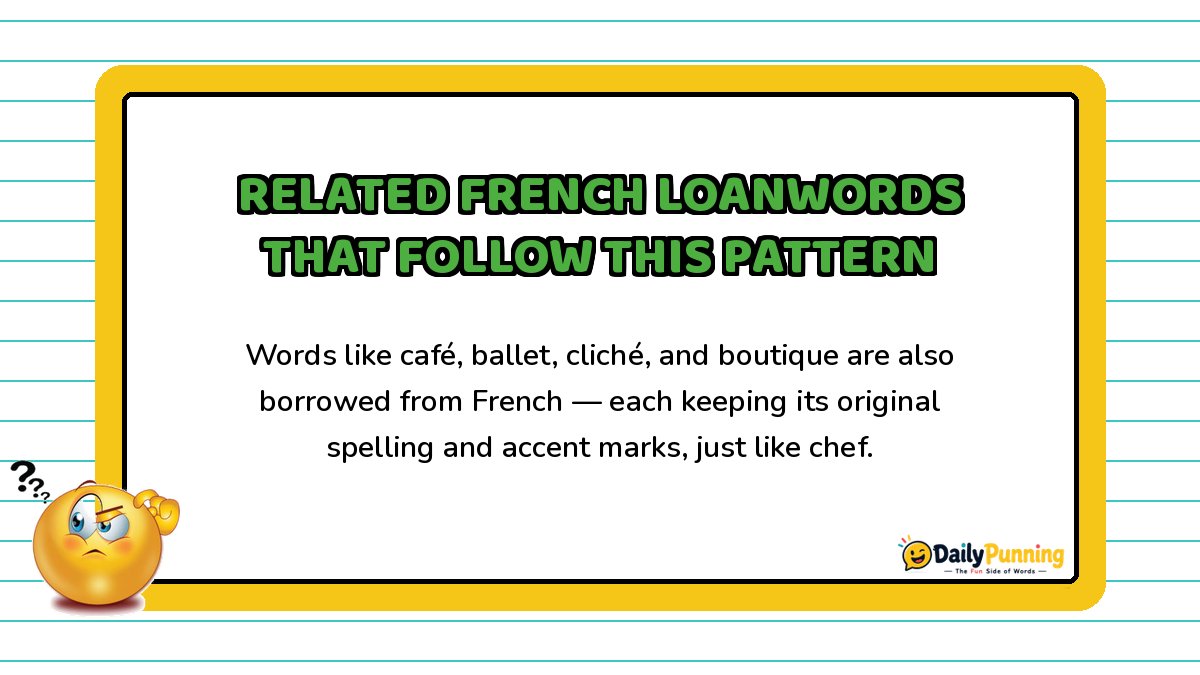
Understanding cheff or chef becomes even easier when you recognize it’s part of a broader pattern of French loanwords in English that retain their original spelling rather than following native English doubling rules:
- Café (not “caff” in formal writing, though “caff” exists as separate British slang)
- Buffet (not “buffett”)
- Cuisine (not “cuisinne”)
- Ballet (not “ballett”)
- Bouquet (not “bouquett”)
Recognizing this broader pattern of French loanwords helps make sense of why cheff or chef resolves the way it does English generally preserves the original spelling of words borrowed from French, rather than reshaping them to fit native English spelling conventions.
FAQs ❓
Is it cheff or chef?
“Chef” is the only correct spelling. “Cheff” is a common misspelling with no valid usage in any English dictionary.
Is “cheff” correct in British English?
No, “chef” is correct in both British and American English, along with every other English-speaking region. There’s no regional variation for this word.
Why do people think “cheff” is correct?
It’s often due to applying English consonant-doubling patterns from words like “staff” or “cliff,” which don’t actually apply to this French loanword.
What does “chef” mean?
A chef is a professional, trained cook, often the head or leader of a kitchen in a restaurant or culinary setting.
How can I remember the correct spelling?
Remember that “chef” comes directly from French and keeps its original single “f” spelling, just like other French food-related loanwords such as “café” and “cuisine.”
What’s the plural of chef?
The plural is “chefs,” adding only an “s” with no other spelling changes.
Are there different types of chefs?
Yes, including executive chef, sous chef, pastry chef, and chef de partie, all of which use the standard “chef” spelling.
Conclusion 🏁
So, when it comes to cheff or chef, the answer is clear and consistent: “chef” is correct, and “cheff” is always a misspelling, regardless of region or context.
Understanding the word’s French origin, its resistance to native English doubling patterns, and its widespread professional usage makes it much easier to remember this distinction as we advance.
Next time you’re writing a menu, describing a cooking show, or talking about someone’s culinary skills, you’ll know exactly which spelling to use with full confidence. ✅👨🍳


