



Table of Contents
ToggleFinalise or Finalize: Which Spelling Is Correct? Full Guide ✅✍️
If you’ve ever paused mid-email or mid-document wondering whether to write finalise or finalize, you’re definitely not alone. This is one of the most commonly searched spelling questions in business and professional English, and like several other similar spelling debates, this one comes down to which English variant you’re using.
In this complete, in-depth guide, we’ll explore every angle of the finalise or finalize debate: the correct spellings, shared meaning, historical origin, grammar rules, regional usage, common mistakes, and plenty of real-world examples. By the end, you’ll never have to hesitate over this word again. ✅
Finalise or Finalize: The Correct Spelling 📝
Here’s the good news right off the bat in the finalise or finalize debate: both spellings are completely correct, depending on your regional English variant: 🎯
- ✅ Finalize – standard in American English
- ✅ Finalise – standard in British, Australian, and Commonwealth English
Unlike genuine misspellings (like “cheff” instead of “chef”), the finalise or finalize question isn’t about right versus wrong. It’s a regional spelling difference, very similar to other well-known American vs. British spelling pairs like “organize” vs. “organise” or “realize” vs. “realise.”
This means that whenever someone asks finalise or finalize, the real answer depends entirely on context specifically, which English-speaking audience, company, or style guide you’re writing for.
Where Does the Word Come From? 📜
To fully understand finalise or finalize, it helps to trace the word back to its roots. It comes from the adjective “final,” itself derived from the Latin word “finalis,” meaning “of or relating to an end.” The suffix “-ize” (or “-ise”) was added to turn the adjective into a verb, meaning “to make final” or “to bring to completion.”
This “-ize/-ise” suffix pattern is actually one of the most common sources of American vs. British spelling variation in English, and understanding this helps explain exactly why finalise or finalize exists as two separate, valid spellings rather than one being a simple typo of the other.
The “-ize” vs “-ise” Suffix Pattern 🕰️
Understanding why finalise or finalize exists as two correct spellings requires looking at the broader “-ize” vs. “-ise” suffix pattern in English. This suffix comes from the Greek “-izein,” and was originally spelled with a “z” even in British English for centuries.
Interestingly, many British style guides including Oxford University Press actually still recommend “-ize” endings (called “Oxford spelling”) as the more historically accurate form, even in British English. However, general modern British usage has largely shifted toward “-ise” endings, likely influenced by French spelling conventions, since French only uses “s” in equivalent verb endings.
Meanwhile, American English standardized on “-ize” consistently, following Noah Webster’s broader spelling reforms in the 18th and 19th centuries, similar to changes like “colour” → “color” and “sceptical” → “sceptical.”
This means that every time you consider finalise or finalize, you’re looking at a small piece of a much larger pattern of “-ize/-ise” verbs that differ between American and general British usage.
American vs British English Spelling 🌍
Let’s break down the regional differences clearly:
- American English: finalize, finalized, finalizing, finalization (all consistently use “z”)
- British English (general usage): finalise, finalised, finalising, finalisation (all consistently use “s”)
- British English (Oxford style): finalize (some British publishers and Oxford-style guides still prefer “-ize”)
- Australian English: typically follows general British conventions finalise, finalised, finalising
- Canadian English: often blends American and British conventions, though “finalize” is common due to strong American influence
This regional split in finalise or finalize follows the exact same broader pattern as several other well-known American vs. British spelling differences:
| American English | British English |
|---|---|
| Finalize | Finalise |
| Organize | Organise |
| Realize | Realise |
| Recognize | Recognise |
| Apologize | Apologise |
So when deciding between finalise or finalize, the real question isn’t which one is “correct” in an absolute sense it’s which one is correct for your intended audience. US-based writing, American companies, and American publications should use “finalize,” while UK, Australian, or Commonwealth writing, companies, and publications should generally use “finalise” (unless following Oxford style specifically).
What Does “Finalize/Finalise” Mean? 🧠
Regardless of which spelling you choose in the finalise or finalize debate, the meaning remains exactly the same. To finalize (or finalise) something means to:
- Complete the last remaining details of a plan, agreement, or document
- Make a decision or arrangement official and unchangeable
- Bring a process, project, or negotiation to its conclusion
- Confirm and settle the final version of something before it’s considered done
Someone who finalizes (or finalises) a contract, itinerary, or report is completing the last steps needed to make it official and ready for use.
Finalize/Finalise in Business & Professional Contexts 💼
Understanding how finalise or finalize is used across professional settings helps reinforce why getting the spelling right matters:
- Business contracts: “Both parties agreed to finalize the terms before signing.” 📄
- Project management: “The team is finalizing the last details of the product launch.” 🚀
- Event planning: “We need to finalize the guest list by Friday.” 🎉
- Legal proceedings: “The divorce settlement was finalized last month.” ⚖️
- Travel arrangements: “Please finalize your booking within 24 hours.” ✈️
In every one of these contexts, whether you write “finalize” or “finalise” depends purely on regional spelling convention, not on any difference in meaning or usage.
Grammar Breakdown of Finalise or Finalize 📖
Understanding the grammar around finalise or finalize can help reinforce correct usage:
- Root word: “final” (adjective)
- Suffix: “-ize” (American) or “-ise” (British), meaning “to make” or “to bring about”
- Part of speech: Verb
- Related noun form: finalization (American) / finalisation (British)
Here’s how the word family breaks down across both spelling conventions:
American English family:
- Finalize (verb – present tense)
- Finalized (verb – past tense)
- Finalizing (verb – present participle)
- Finalization (noun – the process of finalizing)
British English family:
- Finalise (verb – present tense)
- Finalised (verb – past tense)
- Finalising (verb – present participle)
- Finalisation (noun – the process of finalising)
Notice that the “z” vs. “s” pattern remains completely consistent across the entire word family in both spelling systems. This consistency is helpful once you decide which regional spelling you’re using for finalise or finalize, you can apply that same “z” or “s” choice across all related word forms without needing to memorize each one separately.
Common Mistakes People Make ⚠️
When people search finalise or finalize, it’s often because of one of these common issues:
- Mixing spellings within the same document – accidentally switching between “finalize” and “finalise” inconsistently throughout a single piece of writing, which looks unprofessional
- Assuming one version is simply incorrect – unlike genuine spelling errors, both versions are valid; the mistake is assuming there’s only one “correct” answer
- Autocorrect and spellcheck confusion – if your device or software is set to the wrong regional language setting, it may flag the correct spelling for your context as an error
- Inconsistency across related word forms – using “finalize” but then writing “finalisation” in the same document, mixing American and British conventions accidentally
- Ignoring company or publication style guides – not checking whether a workplace or client has a specific established spelling preference
Recognizing these common causes helps explain why finalise or finalize remains one of the more frequently searched spelling questions, especially among business professionals, project managers, and writers working across international teams.
How to Decide Which Spelling to Use ✅
If you’re still unsure which side of finalise or finalize to choose, here’s a simple decision-making guide:
- Identify your audience – Are you writing primarily for American readers, or for British, Australian, or other Commonwealth readers?
- Check your company or client’s style guide – Many businesses have specific style guides that dictate which spelling to use in official documents, emails, and contracts.
- Match your existing content – If you’re writing within a larger document, website, or brand voice, check what spelling convention has already been established and stay consistent.
- Consider your software settings – Check whether your word processor’s language setting is configured for American or British English, as this can help guide (and auto-correct) your spelling choices.
- Stay consistent throughout – Once you’ve chosen a version of finalise or finalize, use that same spelling and its related word forms consistently throughout your entire document.
Example Sentences Using Both Spellings 📚
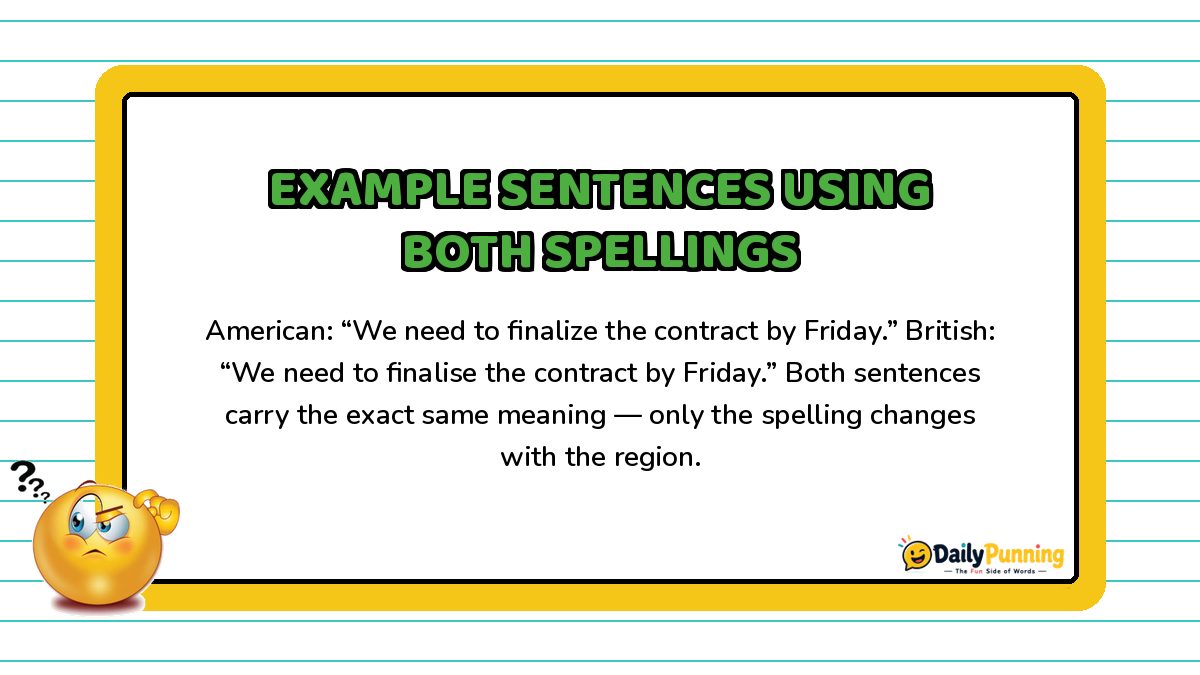
Seeing both versions used naturally in context can help solidify the finalise or finalize distinction:
American English examples:
- “We need to finalize the budget before the meeting.” 💰
- “She finalized her travel plans last night.” ✈️
- “The team is finalizing the last details of the campaign.” 📊
- “Once the contract is finalized, we can move forward.” 📄
- “Finalization of the report is expected by Monday.” 📋
British English examples:
6. “We need to finalise the budget before the meeting.” 💰
7. “She finalised her travel plans last night.” ✈️
8. “The team is finalising the last details of the campaign.” 📊
9. “Once the contract is finalised, we can move forward.” 📄
10. “Finalisation of the report is expected by Monday.” 📋
Notice how the meaning stays identical in every example only the spelling convention changes based on regional context.
Finalise or Finalize in Professional & Academic Writing 💼🎓
Understanding how finalise or finalize applies in professional and academic contexts is particularly important, since consistency matters a great deal in formal writing:
- Business communication: International companies often adopt one spelling convention company-wide to maintain consistency across all official documents, contracts, and internal communication
- Academic papers: Universities and journals typically follow either American or British spelling conventions depending on their country of origin or target publication
- Legal documents: Legal writing tends to be extremely precise, and using the wrong regional spelling consistently throughout a contract could be seen as unprofessional, even though it wouldn’t affect the legal meaning
- Marketing and PR: Brands operating internationally often need to decide on a single spelling convention across all markets or adapt content regionally
Why This Spelling Question Is So Commonly Searched 🔍
It might seem surprising that so many people search finalise or finalize online, but it makes complete sense once you consider a few factors:
- Both spellings are genuinely correct, unlike typical misspellings, which creates real uncertainty rather than a simple right-or-wrong answer
- Many people are only exposed to one regional spelling growing up and are surprised to discover the other version even exists
- Global business communication means people regularly work with international colleagues, clients, and documents using different spelling conventions
- Autocorrect tools sometimes flag the “wrong” version depending on language settings, creating confusion about which one is actually correct
- The word is extremely common in professional and business contexts, increasing the frequency with which people need to write it correctly
All of these factors combine to make finalise or finalize one of the most frequently searched English spelling comparisons, especially among business professionals, project managers, and content creators navigating international audiences.
Finalise or Finalize: A Quick Reference Summary 📋
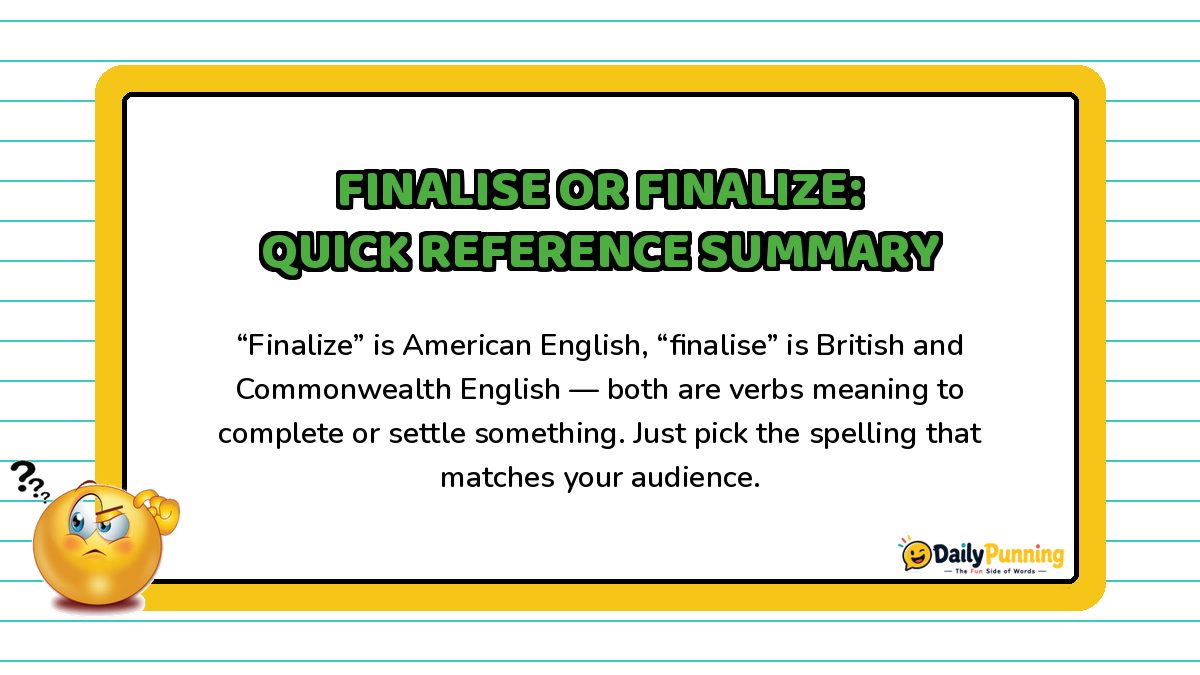
To wrap up the practical side of finalise or finalize, here’s a quick-reference summary you can bookmark for future use:
- Writing for American readers? → Use “finalize,” “finalized,” “finalizing,” and “finalization”
- Writing for British, Australian, or Commonwealth readers? → Use “finalise,” “finalised,” “finalising,” and “finalisation”
- Unsure of your audience? → Choose one version and remain fully consistent throughout your document
- Working within a company or publication? → Follow their established style guide
FAQs ❓
Is it finalise or finalise?
Both are correct; “finalise” is standard American English, while “finalise” is standard British, Australian, and Commonwealth English.
Which spelling should I use for a US audience?
Use “finalize,” along with related forms like “finalized” and “finalization.”
Which spelling should I use for a UK audience?
Use “finalise,” along with related forms like “finalised” and “finalisation,” though some British style guides (like Oxford) still prefer “-ize.”
Do “finalise” and “finalize” mean the same thing?
Yes, both spellings have identical meanings and are pronounced the same way; only the regional spelling convention differs.
Can I mix both spellings in one document?
It’s best to avoid this. Pick one spelling convention and remain consistent throughout your entire piece of writing for a professional, polished result.
Where does the word originally come from?
It comes from the adjective “final,” derived from Latin “finalis,” with the “-ize/-ise” suffix added to form a verb meaning “to make final.”
Does British English always use “finalise”?
Mostly, yes, though some British publishers and style guides (notably Oxford University Press) still recommend the “-ize” ending as historically correct.
Which spelling is used more often globally?
“Finalize” tends to be used more frequently overall due to the size and influence of American media, business, and publishing worldwide.
Conclusion 🏁
So, when it comes to finalise or finalize, there isn’t a single universally “correct” answer; both spellings are completely valid, and the right choice simply depends on your intended audience and regional English convention.
“Finalise” belongs to American English, while “finalise” belongs to general British, Australian, and Commonwealth English, and both share the same meaning: completing and confirming the last details of something.
Now that you understand the origin, grammar, regional differences, and common mistakes surrounding finalise or finalize, you’ll be able to choose confidently and consistently use the correct spelling for your specific audience every single time. ✅📝


