



Onamonapias: What Word Are You Actually Looking For? 🔊✨
If you typed onamonapias into a search bar, you’re definitely not alone this is one of the most commonly misspelled words in the English language! 🤔 People search for this term all the time while actually trying to find information about a completely different (but similarly sounding) word.
In this complete guide, we’ll explain exactly what it’s supposed to be, break down its real meaning, origin, and share plenty of fun, everyday examples. 🔍
What Is “Onamonapias” Actually Supposed to Be? ⚠️

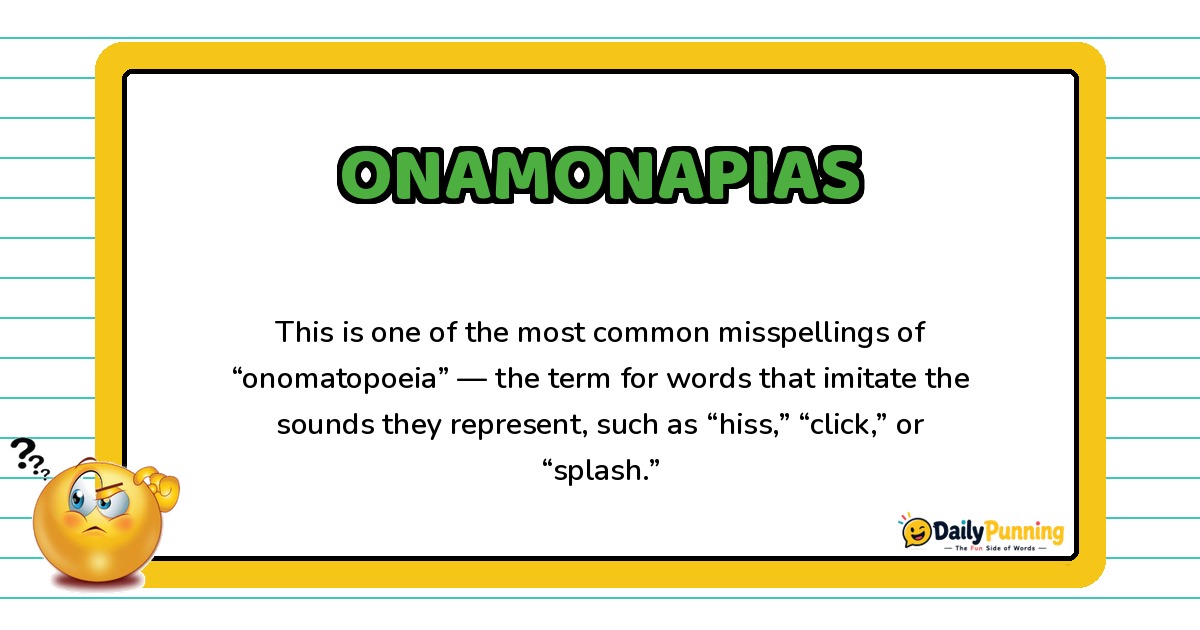
Let’s clear this up right away: onamonapias is not an actual English word it’s a common misspelling of onomatopoeia. Because of its unusual letter combinations, many people searching for this term are really trying to spell:
O-N-O-M-A-T-O-P-O-E-I-A
It’s pronounced roughly as “on-uh-mat-uh-PEE-uh.” So whenever someone types this word, or similar variations like “onomatopeia” or “onomonopia,” they’re almost always looking for the same concept discussed in this article. ✅
What Does Onomatopoeia Actually Mean? 💡
The real word behind this common search onomatopoeia refers to a word that phonetically imitates, resembles, or suggests the actual sound it describes. In other words, these are words that literally sound like the noise they represent. 🔊
For example, the word “buzz” sounds like the noise a bee makes, and “boom” sounds like an explosion. That direct connection between a word’s sound and its meaning is exactly the concept most people are trying to learn about.
Origin of Onomatopoeia 📜
The correctly spelled word comes from Greek, combining “onoma” (meaning “name”) and “poiein” (meaning “to make” or “to create”). Together, it essentially translates to “the making of a name” referring to creating a word that mimics a sound.
This Greek origin also explains why so many people end up misspelling it, since the correct spelling doesn’t follow typical English patterns at all. 🌍
Common Examples of Onomatopoeia 🎉
Once you understand the concept, these examples make everything click:
- Animal sounds 🐝 – buzz, moo, meow, woof, oink
- Nature sounds 🌊 – splash, crackle, rustle, whoosh
- Impact sounds 💥 – boom, bang, crash, thud, smash
- Human sounds 😴 – snore, giggle, gasp, sniffle
- Machine/tech sounds 📱 – beep, honk, ding, click, buzz
Each of these words is a perfect real-world example of the concept people usually want to learn more about.
Onomatopoeia in Comics & Pop Culture 💥

One of the most recognizable uses of this concept is in comic books, where sound effects like “POW!”, “BAM!”, and “KAPOW!” appear in bold, stylized text during action scenes.
This visual and auditory technique helps bring extra energy and excitement to illustrated storytelling exactly the kind of example most people are hoping to understand. 🦸
Onomatopoeia in Poetry & Literature 📖
Writers and poets frequently use this technique to add sensory detail and rhythm to their work, helping readers not just imagine a scene, but almost “hear” it.
Lines describing a “hissing snake,” a “crackling fire,” or “pattering rain” all use this device to bring writing to life in a more immersive way.
Example Sentences Using Onomatopoeia 📚
- “The bees buzzed loudly around the garden.” 🐝
- “The balloon popped with a loud bang.” 🎈
- “Rain pattered gently against the window.” 🌧️
- “The old door creaked as it slowly opened.” 🚪
- “He gulped nervously before speaking.” 😅
Why Do So Many People Misspell This Word? 🤷

It’s easy to see why onamonapias is such a common search term the correct spelling is genuinely tricky, combining unfamiliar Greek roots with a long string of vowels that don’t follow typical English spelling rules.
This is exactly why so many people end up typing variations like “onomatopeia” or other close misspellings while trying to find the same answer. ✍️
FAQs ❓
Is “onamonapias” a real word?
No, it’s a common misspelling of “onomatopoeia,” the correct English word. ✅
What does onomatopoeia actually describe?
It describes a word that imitates or resembles the actual sound it represents, like “buzz” or “boom.” 🔊
What are common examples of onomatopoeia?
Words like buzz, splash, boom, meow, and crackle are all classic real-world examples.
Why is this word spelled so unusually?
Because it comes from Greek roots (“onoma” + “poiein”), which don’t follow standard English spelling patterns.
How do you correctly spell onomatopoeia?
The correct spelling is o-n-o-m-a-t-o-p-o-e-i-a.
Conclusion
So, if you searched for onamonapias, you were actually looking for “onomatopoeia” a word that imitates the sound it describes, like buzz, boom, or splash.
Beyond just being a tricky word to spell, this concept plays a big role in comics, poetry, and everyday language, adding energy and sensory detail to how we describe the world around us.
Now you’ll know exactly what you were searching for, how to spell it correctly, and how to spot it in the wild. 🎉


