



Table of Contents
ToggleTMI Full Form in Chat: What Does It Really Mean? 🙈📱
Seen someone reply “TMI” after you shared a little too much detail? You’re definitely not alone; it’s one of the most commonly used reaction acronyms in texting today.
In this complete, in-depth guide, we’ll break down the TMI full form in chat, where it comes from, how people use it across different platforms, and how to respond when someone throws it your way. ✅
What Is the TMI Full Form in Chat? 📝
The TMI full form in chat stands for “Too Much Information.” 🙈 It’s used as a reaction when someone shares details that are overly personal, uncomfortable, awkward, or simply more than the listener wanted or needed to know.
It’s typically said (or texted) in a lighthearted, joking way, though it can occasionally carry a more serious tone if the shared information genuinely crosses a boundary.
Full Breakdown of TMI 📖
Understanding the TMI full form in chat letter by letter makes it easy to remember:
- T – Too
- M – Much
- I – Information
Put together, the TMI full form in chat simply means someone has shared more personal or graphic detail than was necessary or comfortable for the conversation. 😅
Origin & History of TMI 📜
Like most texting acronyms, the TMI full form in chat doesn’t trace back to one single inventor or documented first use. The phrase “too much information” actually predates modern texting, showing up in casual spoken conversation as early as the 1990s, often used humorously when someone overshared personal details, medical information, or awkward stories.
As texting and instant messaging became widespread in the 2000s, the phrase naturally shortened into the acronym “TMI,” fitting perfectly into fast-paced digital conversations where brevity matters. Since then, the TMI full form in chat has remained remarkably stable in meaning, unlike many slang terms that shift or fade over time.
How People Use TMI in Daily Conversations 💬
In everyday texting, the TMI full form in chat typically shows up as a quick reaction to oversharing:
- “I had the worst stomach ache last night, spent like an hour in the bathroom.” → “TMI!! 😂”
- “My ex texted me at 3 am again…” → “Ok TMI but go on lol”
- “I haven’t showered in three days.” → “TMI dude 😭”
In each of these examples, the TMI full form in chat signals that the shared detail was a bit more than the listener expected or wanted, usually in a playful, teasing way rather than a harsh one.
TMI Meaning Across WhatsApp, Instagram, TikTok & Snapchat 📲
The TMI full form in chat stays consistent across platforms, though the tone can shift slightly:
- WhatsApp 💚 – Common in personal chats and group conversations, reacting to oversharing
- Instagram comments/DMs 📸 – Used when someone shares an overly personal detail in a caption or story
- TikTok comments 🎵 – Frequently used humorously when a video shares surprisingly personal or graphic details
- Snapchat 👻 – Common in casual back-and-forth chats between friends
Regardless of platform, the TMI full form in chat carries the same core meaning: a reaction to information that felt like more than was needed.
Different Contexts Where TMI Is Used 🔍
Beyond casual texting, the TMI full form in chat shows up in several recognizable contexts:
- Medical or bodily details – oversharing about illness, bathroom habits, or physical symptoms 🤢
- Relationship details – sharing overly intimate details about a romantic relationship 💔
- Personal habits – mentioning something a bit too personal about daily routines 🛁
- Family drama – sharing very private family conflicts or issues in a casual setting 👪
- Workplace oversharing – mentioning personal details that feel out of place in a professional setting 🏢
In all of these situations, the TMI full form in chat serves as a quick, recognizable way to flag that the conversation has crossed into overly personal territory.
Is TMI Always Meant Negatively? ⚠️
Not necessarily. While the TMI full form in chat does point out that something was shared unnecessarily, it’s usually said in a light, joking tone rather than as a serious criticism.
Friends often use it playfully to tease each other about oversharing, without any real judgment behind it. However, in some cases, especially in professional or more formal settings, it can be a polite way of signaling that a boundary has been crossed and the topic should shift.
Common Confusions & Mistakes 🚫
A few common misunderstandings surround the TMI full form in chat:
- Assuming it’s always harsh – most of the time it’s lighthearted and joking, not meant to shame the sender
- Using it in professional settings – while it can politely signal a boundary at work, it’s still considered casual slang, so tone matters
- Confusing it with other similar acronyms – some people mistake TMI for unrelated texting shorthand with different meanings
- Ignoring the humor behind it – TMI is often used as comic relief rather than a serious complaint
Recognizing these nuances helps clarify the TMI full form in chat and how to use or interpret it appropriately.
Similar Terms & Related Slang 🔗
The TMI full form in chat belongs to a small family of reaction-based texting acronyms:
- IYKYK – If You Know You Know
- NGL – Not Gonna Lie
- IDC – I Don’t Care
- SMH – Shaking My Head
These terms share a similar function: quick reactions that add tone and personality to casual digital conversations.
Examples of TMI in Real Chat Situations 💌
Seeing the TMI full form in chat used naturally in context helps solidify its meaning:
Example 1:
A: “I think I ate something bad, I’ve been in the bathroom all morning.” 🤢
B: “TMI! But hope you feel better lol.”
Example 2:
A: “My date last night was a disaster, he told me way too much about his ex within the first ten minutes.” 😬
B: “Ok that’s definitely TMI on his part.”
Example 3:
A: “I haven’t done laundry in two weeks, I’m just rotating the same three outfits.” 😅
B: “TMI but also relatable.”
How to Respond When Someone Says TMI 💡
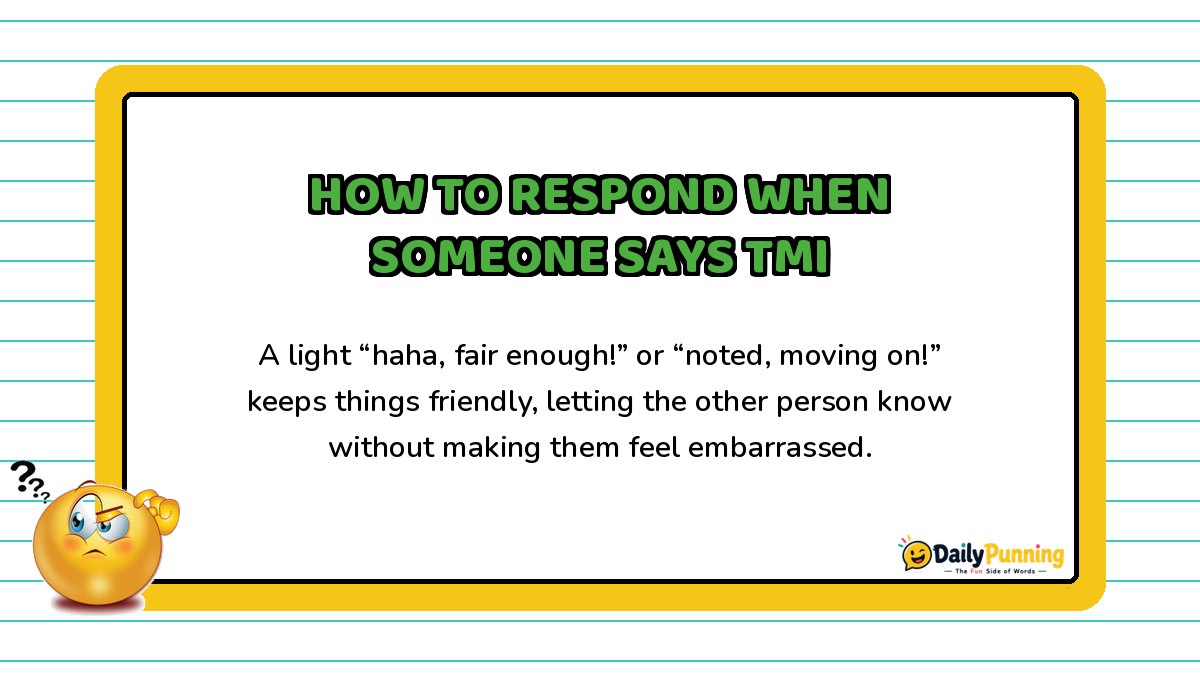
If someone replies with the TMI full form in chat after you’ve shared something, here are a few natural ways to respond:
- Laugh it off: “Haha sorry, didn’t mean to overshare!” 😂
- Acknowledge and move on: “Yeah that was a lot, anyway…”
- Own it playfully: “No such thing as TMI between us!” 😜
The key is matching the light, casual tone the reaction was given in.
TMI in Professional & Formal Settings 💼
While the TMI full form in chat is mostly used casually, it occasionally shows up in professional contexts too, usually as a polite, subtle way of signaling that a conversation has drifted into overly personal territory.
In workplace chats or emails, it’s still considered informal slang, so it’s typically only used among coworkers who have a casual, friendly rapport rather than in formal communication with clients or senior management.
Is TMI Still Commonly Used? 📊
Yes the TMI full form in chat remains one of the most consistently recognized reaction acronyms across texting and social media platforms. Unlike many slang terms that rise and fall in popularity, “Too Much Information” has stayed relevant for decades, both in spoken conversation and digital messaging, because oversharing is a universal, relatable experience that never really goes out of style.
Why TMI Remains So Relatable 🌟
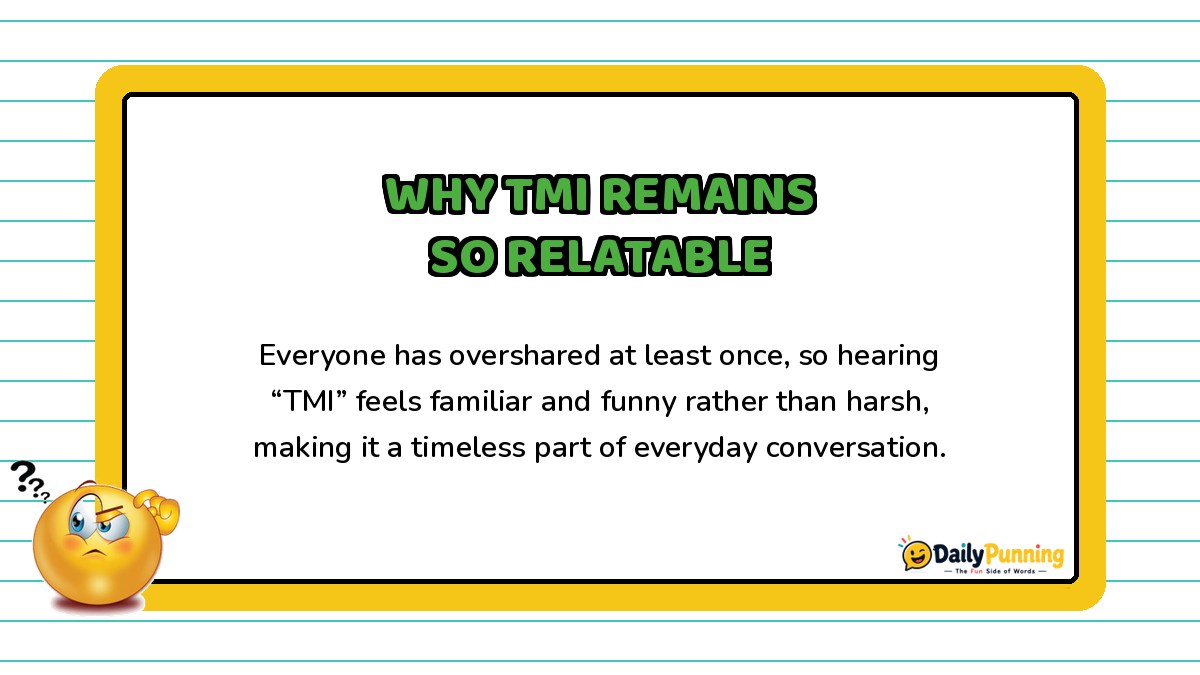
Part of why the TMI full form in chat has stuck around so long is that oversharing is something almost everyone has experienced, either as the person sharing too much or the person on the receiving end.
Whether it’s a friend describing an awkward medical situation in too much detail or someone venting about a relationship issue that feels overly personal for the setting, TMI captures that universal, slightly cringeworthy moment in a quick, recognizable way. This relatability is exactly why the phrase has remained a staple of casual conversation both offline and online.
FAQs About TMI ❓
What is the TMI full form in chat?
The TMI full form in chat stands for “Too Much Information,” used when someone shares overly personal or excessive details.
Is TMI meant to be rude?
Not usually it’s typically lighthearted and joking rather than a serious criticism.
Can TMI be used in professional settings?
It can, but it’s still informal slang, so it’s best used among coworkers with a casual rapport rather than in formal communication.
What’s an example of TMI?
Sharing overly detailed medical symptoms, relationship drama, or personal habits in a casual conversation are common examples.
How should I respond to TMI?
A lighthearted reply like “Haha sorry, didn’t mean to overshare!” works well in most casual contexts.
Where did TMI originate?
The phrase predates texting, appearing in casual spoken conversation as early as the 1990s before shortening into the acronym form.
Is TMI still commonly used today?
Yes, the TMI full form in chat remains widely recognized and used across texting and social media platforms today.
Conclusion 🏁
So, what is the TMI full form in chat? It simply stands for “Too Much Information,” a quick, often playful way of reacting when someone shares more personal or excessive detail than the conversation called for.
Whether it’s an awkward medical story, an overly detailed relationship update, or a random personal habit, TMI captures that universally relatable moment of oversharing in just three letters.
Now that you know exactly what it means and how to use or respond to it, you’ll never be caught confused by this common chat reaction again. 🙈✅


