



TTS Full Form: What Does TTS Really Stand For? 🔊📱
Seen “TTS” on TikTok, in an app setting, or in a text and wondered what it actually means? 🤔 It’s a widely used acronym across technology and social media, with a meaning that stays fairly consistent no matter where you encounter it. In this complete guide, we’ll break down the full TTS full form — its definition, origin, common usage, and how it shows up differently across various platforms. 🔍
What Is the TTS Full Form? 📝
The most common TTS full form stands for “Text-To-Speech” 🔊 — a technology that converts written text into spoken audio using a computer-generated voice. It’s used across countless apps, devices, and platforms to read text aloud instead of requiring a person to read it visually. 📱
In certain casual texting or social media contexts, TTS full form can occasionally refer to “Time To Shine”, used as an encouraging phrase, though the technology-related meaning is by far the most common and widely recognized across nearly every context.
Breaking Down the TTS Full Form Letter by Letter
- T – Text
- T – To
- S – Speech
So the primary TTS full form breaks down simply to: technology that transforms written text into spoken words, read aloud by a synthetic or computer-generated voice. 🗣️
Origin & History of TTS 📜
The TTS full form actually has roots going back much further than most people realize. Text-to-speech technology dates back to the mid-20th century, with early experimental speech synthesis systems developed by researchers exploring how computers could generate human-like speech from written input. By the 1970s and 1980s, more advanced TTS systems began appearing in accessibility tools, helping visually impaired users have text read aloud to them. 💻
As computing power increased and voice synthesis technology improved dramatically, the TTS full form expanded far beyond accessibility tools into everyday consumer technology — GPS navigation systems, virtual assistants like Siri and Alexa, e-readers, and eventually social media platforms all began incorporating text-to-speech features, making the once niche technology a completely mainstream part of daily digital life. 📖
How TTS Is Used Today 💬
Understanding the modern TTS full form means recognizing just how widespread the technology has become across nearly every type of digital platform:
- Accessibility tools – helping visually impaired users navigate websites, documents, and apps
- Navigation systems – GPS apps reading directions aloud while driving
- Virtual assistants – Siri, Alexa, and Google Assistant using TTS to respond verbally to spoken requests
- E-books and audiobooks – converting written text into audio for hands-free reading
- Social media content – TikTok and Instagram videos using synthetic TTS voices for narration or comedic effect
TTS on TikTok & Social Media 📲
One of the most culturally significant modern uses of the TTS full form comes from TikTok, where creators frequently use the platform’s built-in text-to-speech feature to narrate captions, jokes, stories, or comments using a recognizable robotic-sounding voice. This became such a popular trend that the TTS voice itself became a meme and stylistic choice, often used specifically for comedic timing or dramatic emphasis rather than pure accessibility.
- TikTok 🎵 – Extremely popular for storytelling videos, comedic skits, and reading out loud comments or captions
- Instagram Reels 📸 – Similar text-to-speech features used for captions and narration
- YouTube Shorts ▶️ – Creators using TTS voices for quick, low-effort narration in short-form videos
Common Confusions & Mistakes ⚠️
A few common misunderstandings surround the TTS full form:
- Assuming TTS always refers to the specific TikTok voice meme, when it’s actually a much broader, decades-old technology term
- Confusing “Text-To-Speech” with “Speech-To-Text,” which is the reverse technology (converting spoken words into written text)
- Assuming casual slang meanings like “Time To Shine” are as common as the technology meaning, when they’re actually far less frequently used
Similar Terms & Related Technology 🔗
The TTS full form exists alongside a few related technology acronyms often used in similar contexts:
- STT – Speech-To-Text, the reverse process of converting spoken audio into written text
- AI voice generation – broader technology encompassing TTS along with more advanced synthetic voice creation
- ASR – Automatic Speech Recognition, technology used to understand spoken language
How TTS Technology Actually Works 🧠
Beyond just the acronym, it helps to understand the basic process behind the TTS full form technology itself. Modern text-to-speech systems typically follow a few key steps:
- Text analysis – breaking down written input into words, punctuation, and sentence structure
- Linguistic processing – determining pronunciation, emphasis, and natural pacing
- Voice synthesis – generating audio output using either recorded voice samples or fully AI-generated synthetic voices
- Playback – delivering the final spoken audio to the user through speakers or headphones
Older TTS systems relied heavily on robotic-sounding, pre-recorded voice fragments stitched together, which is part of why early text-to-speech voices sounded distinctly unnatural. Modern systems increasingly use AI and machine learning to generate far more natural, human-like speech patterns, complete with realistic intonation and emotion.
TTS in Accessibility & Assistive Technology ♿
One of the most important and often overlooked applications of the TTS full form is its role in accessibility technology. For visually impaired or blind users, text-to-speech software has been transformative, allowing them to navigate websites, read documents, respond to emails, and use apps independently without relying on someone else to read content aloud to them.
Screen readers, which rely heavily on the TTS full form technology, have become standard accessibility tools built directly into most major operating systems, including Windows, macOS, iOS, and Android. This makes TTS not just a fun social media trend, but a genuinely essential piece of technology that improves independence and quality of life for millions of users worldwide. 🌍
TTS in Education & Learning 📚
Beyond accessibility and entertainment, the TTS full form has also found meaningful use within education. Many students, particularly those with learning differences like dyslexia, benefit from having text read aloud to them, improving comprehension and reducing reading fatigue. Educational apps and e-readers increasingly build in TTS features specifically to support diverse learning styles and needs.
Language learners also frequently use TTS tools to hear correct pronunciation of new vocabulary, helping bridge the gap between written and spoken language acquisition. This educational application shows just how far the TTS full form technology has expanded beyond its original accessibility-focused roots. 🎓
The Evolution of TTS Voice Quality Over Time 🎙️
Understanding the TTS full form also means appreciating just how dramatically the underlying technology has improved over the decades. Early text-to-speech systems from the 1970s and 1980s sounded distinctly robotic and monotone, often struggling with natural pacing, emphasis, or emotional tone. These early voices, while groundbreaking for their time, were immediately recognizable as computer-generated.
Modern TTS systems, powered increasingly by artificial intelligence and deep learning models, have closed much of that gap. Many current text-to-speech voices sound remarkably natural, complete with realistic pauses, intonation changes, and even emotional expressiveness that would have seemed impossible just a couple decades ago. This rapid improvement is part of why the TTS full form technology has become so seamlessly integrated into everyday products without users even thinking twice about it.
Business & Customer Service Uses of TTS 📞
Companies across nearly every industry now rely on the TTS full form technology for customer service and business communication. Automated phone systems frequently use TTS to read out account information, confirm orders, or guide callers through menus without needing a live human voice recording for every possible message. This flexibility allows businesses to update information dynamically without re-recording audio every time details change.
Additionally, many companies use TTS in their apps and websites to improve accessibility compliance, ensuring their digital products remain usable for customers with visual impairments or reading difficulties — both a legal requirement in many regions and simply good practice for inclusive design.
Is TTS Still Widely Used Today? 📊
Yes — the TTS full form remains extremely relevant and widely used, especially as accessibility technology, AI voice assistants, and social media content creation continue to grow rapidly. If anything, TTS technology has become significantly more advanced and more embedded into everyday digital experiences than ever before. 🌍
TTS vs. AI Voice Cloning: What’s the Difference? 🤖
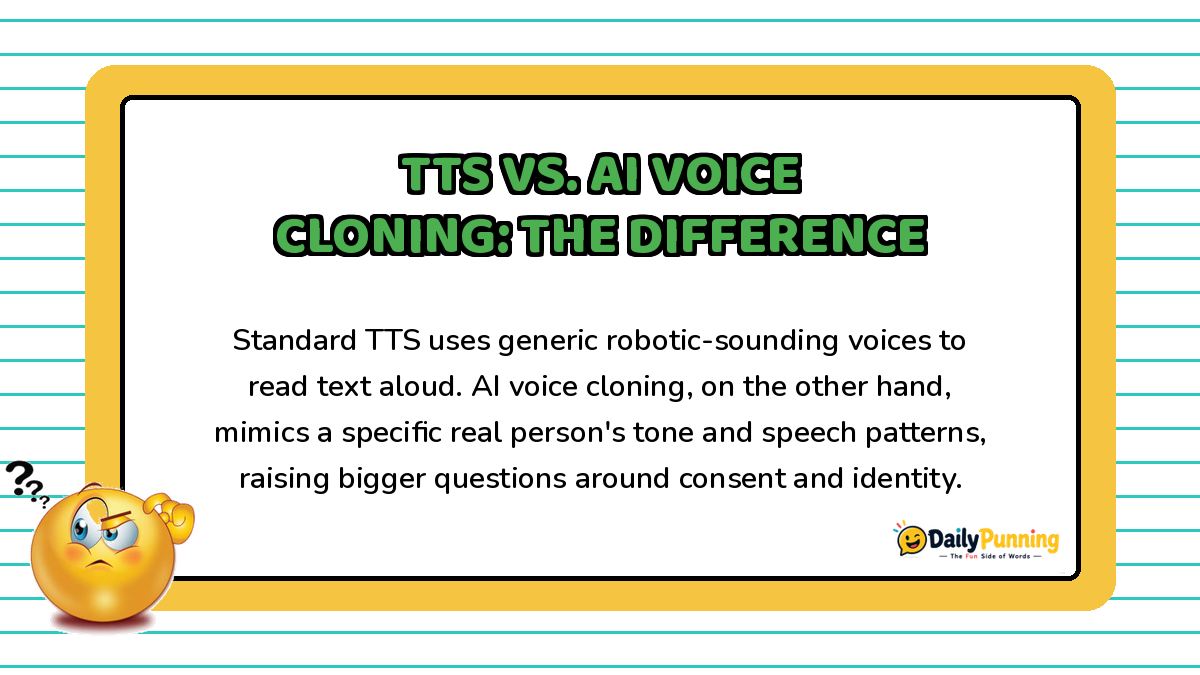
As artificial intelligence has advanced, it’s worth distinguishing the traditional TTS full form technology from newer AI voice cloning tools. Standard text-to-speech uses pre-built synthetic voices designed to sound generically natural, without mimicking any specific real person. Voice cloning, on the other hand, uses AI models trained on samples of a specific individual’s voice to recreate that exact person’s speech patterns and tone.
While both technologies fall under the broader umbrella of speech synthesis, understanding the TTS full form as distinct from voice cloning helps clarify important ethical and practical differences — standard TTS voices are generic and widely available, while voice cloning raises additional considerations around consent, identity, and potential misuse that traditional text-to-speech tools generally don’t involve.
FAQs ❓
What does TTS stand for?
The TTS full form most commonly stands for “Text-To-Speech,” technology that converts written text into spoken audio. 🔊
Is TTS the same as Speech-To-Text?
No, they’re opposites — TTS converts text into speech, while Speech-To-Text (STT) converts spoken audio into written text.
Why is TTS popular on TikTok?
Creators use TikTok’s built-in TTS voice feature to narrate captions or stories, often for comedic or dramatic effect.
Q4: Can TTS mean something else besides Text-To-Speech? Occasionally, in casual texting or slang, TTS can mean “Time To Shine,” though this is far less common than the technology meaning.
Q5: Is TTS technology only used for accessibility?
No, while it started as an accessibility tool, TTS is now used across navigation apps, virtual assistants, audiobooks, and social media content.
Conclusion
The TTS full form most commonly refers to “Text-To-Speech,” a widely used technology that converts written text into spoken audio, powering everything from accessibility tools and GPS navigation to virtual assistants and viral TikTok narration.
Understanding this simple acronym helps clarify one of the most common and useful pieces of modern technology terminology. Whether you encounter it in an app setting, on social media, or in casual conversation, you’ll now always know exactly what TTS means. 🎉


