



Table of Contents
ToggleRacoon vs Raccoon: Which Spelling Is Correct? 🦝✍️
If you’ve ever paused mid-sentence wondering whether it’s “racoon” or “raccoon,” you’re definitely not alone. This is one of the most commonly mixed-up animal names in English, mostly because the double “c” doesn’t match how the word sounds when spoken aloud.
In this complete guide, we’ll settle the racoon vs raccoon debate once and for all, covering the correct spelling, where the confusion comes from, the word’s origin and meaning, cultural facts, common mistakes, memory tricks, and plenty of real example sentences so you’ll never second-guess yourself on this word again. ✅
Racoon vs Raccoon: The Correct Spelling 📝
Let’s get straight to the answer: in the racoon vs raccoon debate, “raccoon” is the correct and standard spelling in English. 🎯
- ✅ Raccoon (correct)
- ❌ Racoon (common misspelling)
This holds true across American, British, Canadian, and Australian English there’s no regional variation here like there is with words such as “color” vs. “colour.”
No matter where you’re writing from, “raccoon” with the double “c” is the spelling recognized by every major dictionary, including Merriam-Webster, Oxford, and Cambridge.
Why Do People Confuse Racoon vs Raccoon? 🤔
The mix-up in racoon vs raccoon happens because the double “c” doesn’t create an obvious sound difference when the word is spoken. Since “raccoon” is pronounced with a single hard “k” sound in the middle, many people naturally assume a single “c” is enough to spell it, similar to simpler patterns found in other English words.
This is a classic case of a word’s spelling not perfectly matching its pronunciation, which trips up even confident spellers. It’s the same type of mismatch that causes trouble with words like “necessary” (one “c,” two “s”s) or “accommodate” (double “c,” double “m”) English is full of these silent-doubling traps.
Where Does the Word “Raccoon” Come From? 📜
Understanding the origin helps explain why the racoon vs raccoon debate always favours the double “c.” The word comes from the Powhatan language (an Algonquian language spoken by Indigenous peoples in Virginia), from a word roughly meaning “one who scratches with the hands” a reference to the animal’s dexterous front paws.
As the word passed into English through early colonial contact in the 17th century, it went through a few spelling variations, including forms like “roughout” and “arathkone,” before eventually settling into the modern “raccoon,” which retained the double “c” from its transitional forms.
This linguistic journey is actually fairly common for English words borrowed from Indigenous American languages words like “moose,” “skunk,” and “opossum” all followed similar paths, entering English through early settler contact and gradually taking on standardized spellings that don’t always intuitively match their pronunciation today.
What Does “Raccoon” Mean? 🦝
Beyond the racoon vs raccoon spelling question, it’s worth knowing what the word actually refers to: a raccoon is a medium-sized, nocturnal mammal known for its distinctive black facial “mask,” ringed tail, and remarkably dexterous front paws, which it uses to manipulate food and objects with almost hand-like precision.
Raccoons are native to North America and are known for being highly adaptable, often thriving in both wild and urban environments, from forests and wetlands to city alleys and suburban backyards.
Raccoon Behavior & Fun Facts 🌙
Since we’re already exploring the word thoroughly, it’s worth touching on a few interesting facts about the animal itself:
- Raccoons are primarily nocturnal, meaning they’re most active at night 🌙
- They have incredibly sensitive front paws, often compared to human hands in dexterity 🖐️
- Raccoons are known for appearing to “wash” their food, though this behavior is more about sensory exploration than actual cleaning 💧
- They’re highly adaptable omnivores, eating everything from fruit and insects to small animals and human food scraps 🍇
- Raccoons can be found throughout most of North America, and related species exist in parts of Europe and Asia due to introduction
Knowing these details about the actual animal can help reinforce the correct spelling, since context and familiarity often go hand in hand with better spelling retention.
Grammar & Spelling Breakdown 📖
Breaking the word down letter by letter makes the racoon vs raccoon distinction easier to remember:
- R
- A
- C
- C
- O
- O
- N
Notice the double “c” right after the initial “ra,” followed by a double “o.” Both double letters are essential parts of the correct spelling, and dropping either one results in a common misspelling. Interestingly, the double “o” rarely trips people up it’s almost always the double “c” that gets reduced to a single letter by mistake.
Common Mistakes People Make ⚠️
When people search racoon vs raccoon, it’s usually due to one of these common issues:
- Single “c” mistake – writing “racoon” instead of “raccoon,” by far the most frequent error
- Autocorrect gaps – some spellcheck tools don’t always flag “racoon” immediately as incorrect, especially in casual typing apps
- Phonetic spelling – relying on how the word sounds rather than its actual written form, since the double “c” doesn’t audibly register
- Fast typing or texting – dropping a letter in casual, quick writing where accuracy isn’t closely checked
- Non-native English speakers – learners sometimes simplify double letters since many languages don’t use doubled consonants the same way English does
Is “Racoon” Ever Correct? ❌
To be fully clear on racoon vs raccoon: “racoon” is not recognized as a standard or alternate spelling in any major English dictionary. It’s simply a common misspelling, not a regional variant like “color” vs. “colour” or “theater” vs. “theatre.”
Everywhere raccoons are discussed nature documentaries, wildlife guides, scientific articles, or casual conversation “raccoon” with the double “c” is the only correct form recognized in professional and academic writing.
Raccoon vs Similar Confusing Animal Names 🐾
Interestingly, raccoon isn’t alone in causing spelling confusion. Several other animal names trip people up for similar reasons:
- Chihuahua – often misspelled due to its unusual letter pattern
- Rhinoceros – frequently shortened or misspelled as “rhinocerous”
- Hippopotamus – commonly simplified in casual writing
- Mongoose – sometimes pluralized incorrectly as “mongeese”
Recognizing that raccoon belongs to this broader category of tricky animal spellings can help normalize the confusion it’s a common pattern, not a sign of poor spelling skills.
Example Sentences Using “Raccoon” 📚
- “A raccoon knocked over our trash cans last night.” 🗑️
- “The raccoon’s ringed tail makes it easy to identify.” 🦝
- “Raccoons are known for washing their food before eating.” 💧
- “We spotted a raccoon climbing the tree in our backyard.” 🌳
- “The wildlife documentary featured a family of raccoons.” 🎥
- “Raccoons are surprisingly intelligent problem-solvers.” 🧠
- “A curious raccoon peeked into our tent while camping.” ⛺
How to Remember the Correct Spelling 💡
- Double letters, double trouble: remember both the “cc” and the “oo” appear together
- Think of “raccoon” as two pairs: “cc” + “oo”
- Visualize the mask: picture the raccoon’s black mask and ringed tail while spelling the word, linking the image to the spelling
- Compare with similar animal names: many English animal names have quirky spellings worth double-checking
- Practice writing it in full sentences to lock in the correct pattern over time
Why This Spelling Confusion Is So Common 🔍
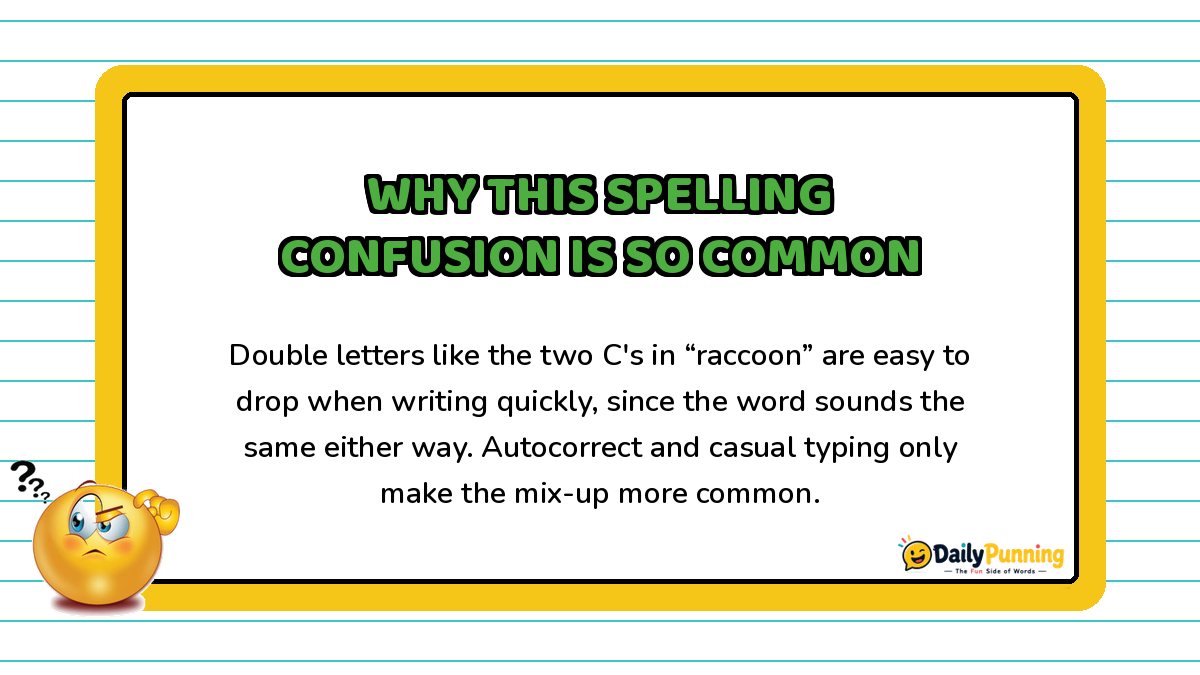
It might seem surprising that so many people search racoon vs raccoon online, but it makes sense given a few factors: the word’s pronunciation doesn’t hint at the double “c,” English borrowed the word from an Indigenous language with its own unrelated spelling conventions, and casual digital writing often skips careful proofreading.
All of these factors combine to make this one of the more frequently searched animal-name spelling questions in English.
FAQs ❓
Is it racoon or raccoon?
“Raccoon” is the correct spelling, with a double “c.” “Racoon” is a common misspelling.
Does British English spell it differently?
No “raccoon” is spelled the same way in both American and British English.
Where does the word raccoon come from?
It comes from a Powhatan (Algonquian) word meaning roughly “one who scratches with the hands.”
What does a raccoon look like?
A raccoon has a black facial mask, a ringed tail, and highly dexterous front paws.
How can I remember the correct spelling?
Remember it has two sets of doubled letters: “cc” and “oo.”
Are raccoons found outside North America?
Yes, raccoons have also been introduced to parts of Europe and Asia, where they’ve established wild populations.
Conclusion 🏁
So, when it comes to racoon vs raccoon, the answer is clear: “raccoon,” with its double “c” and double “o,” is the only correct spelling, and this holds true across every major English variant worldwide.
The confusion mostly stems from the word’s pronunciation not perfectly matching its written form, a common trap rooted in its Indigenous Powhatan origins.
Now that you understand the correct spelling, its history, some fun facts about the animal itself, and a few simple memory tricks to lock it in, you’ll never have to hesitate over this word again in any writing context. ✅🦝


