



Table of Contents
ToggleSceptical or Skeptical: Which Spelling Is Correct? Full Guide 🤔✍️
If you’ve ever paused mid-sentence wondering whether to write sceptical or skeptical, you’re definitely not alone. This is one of the most commonly searched spelling questions in English, and unlike some spelling debates that have one clear right answer, this one actually comes down to which English variant you’re using.
In this complete, in-depth guide, we’ll explore every angle of the sceptical or skeptical debate, the correct spellings, their shared meaning, historical origin, grammar rules, regional usage, common mistakes, and plenty of real-world examples. By the end, you’ll never have to hesitate over this word again. ✅
Sceptical or Skeptical: The Correct Spelling 📝
Here’s the good news right off the bat in the sceptical or skeptical debate: both spellings are completely correct, depending on your regional English variant: 🎯
- ✅ Skeptical – standard in American English
- ✅ Sceptical – standard in British, Australian, and Commonwealth English
Unlike some spelling mix-ups where one version is simply wrong (like “presentor” instead of “presenter”), the sceptical or skeptical question isn’t about right versus wrong. It’s a genuine regional spelling difference, very similar to other well-known American vs. British spelling pairs like “color” vs. “colour” or “organize” vs. “organise.”
This means that whenever someone asks sceptical or skeptical, the real answer depends entirely on context specifically which English-speaking audience or style guide you’re writing for.
Where Does the Word Come From? 📜
To fully understand sceptical or skeptical, it helps to trace the word back to its roots. The word originates from the Ancient Greek term “skeptikos,” which meant “inquiring,” “reflective,” or “thoughtful” describing someone who questions and examines ideas rather than blindly accepting them.
From Greek, the word passed into Latin as “scepticus,” and later into French, before eventually making its way into English. Because the word entered English through slightly different linguistic paths and at different historical points, both the “sc” and “sk” spelling conventions developed and eventually became standardized in different regions of the English-speaking world.
This historical journey is actually key to understanding why sceptical or skeptical isn’t simply a case of one spelling being a typo of the other. Both forms have deep historical roots and legitimate linguistic backing; they just took slightly different paths into modern English.
The Historical Split: Why Two Spellings Exist 🕰️
Understanding why sceptical or skeptical exists as two separate correct spellings requires a bit of a history lesson. During the 18th and 19th centuries, as American English began to diverge from British English, a broader movement toward spelling reform took hold in the United States, largely influenced by lexicographer Noah Webster.
Webster believed that American English should simplify and standardize spelling in ways that made more phonetic sense and distinguished American writing from British conventions. This led to changes such as:
- “Colour” → “color”
- “Centre” → “center”
- “Defence” → “defence”
- “Sceptical” → “sceptical”
The shift from “sc” to “sk” in words like sceptical or skeptical fits into this broader pattern of American spelling reform, where “k” was often favored over “c” in certain word constructions to better reflect pronunciation. Meanwhile, British English retained the older, more traditional “sc” spelling, closer to the word’s Latin and Greek roots.
This means that every time you consider sceptical or skeptical, you’re actually looking at a small piece of a much larger linguistic history involving the intentional divergence of American and British spelling conventions.
American vs British English Spelling 🌍
Let’s break down the regional differences clearly:
- American English: skeptical, skeptic, skepticism (all consistently use “k”)
- British English: sceptical, sceptic, scepticism (all consistently use “c”)
- Australian English: typically follows British conventions: sceptical, sceptic, scepticism
- Canadian English: often follows British spelling for this particular word, though Canadian English is known for blending American and British conventions across different words
This regional split in sceptical or skeptical follows the exact same pattern as several other well-known American vs. British spelling differences:
| American English | British English |
|---|---|
| Skeptical | Sceptical |
| Defense | Defence |
| License | Licence |
| Color | Colour |
| Organize | Organise |
So when deciding between sceptical or skeptical, the real question isn’t which one is “correct” in an absolute sense it’s which one is correct for your intended audience.
US-based writing, American publications, and American academic institutions should use “skeptical,” while UK, Australian, or Commonwealth writing, publications, and institutions should use “sceptical.”
What Does “Skeptical/Sceptical” Mean? 🧠
Regardless of which spelling you choose in the sceptical or skeptical debate, the meaning remains the same. Being sceptical (or sceptical) means:
- Having doubts about the truth or validity of a claim
- Questioning something rather than accepting it immediately at face value
- Requiring evidence or proof before believing a statement
- Maintaining a cautious, questioning attitude toward new information
Someone described as skeptical or sceptical tends to approach claims, arguments, or new information with a careful, questioning mindset rather than blind acceptance. This trait is often associated with critical thinking, scientific reasoning, and careful decision-making.
Skepticism as a Broader Concept 🔍
Beyond just the spelling question of sceptical or skeptical, it’s worth understanding skepticism as a broader philosophical and practical concept. In philosophy, skepticism refers to a school of thought that questions the possibility of certain knowledge, examining whether we can truly know anything with complete certainty.
In everyday usage, however, being sceptical (or sceptical) simply means approaching claims with healthy doubt rather than automatic belief. This applies in numerous contexts:
- Scientific skepticism: Questioning claims that lack sufficient evidence or haven’t been properly tested 🔬
- Consumer skepticism: Doubting exaggerated advertising claims before making a purchase 🛒
- Everyday skepticism: Being cautious about rumors, gossip, or unverified information 💬
- Journalistic skepticism: Verifying facts and sources before publishing information as true 📰
In every one of these contexts, whether you write “sceptical” or “sceptical” depends purely on regional spelling convention, not on any difference in meaning.
Grammar Breakdown of Sceptical or Skeptical 📖
Understanding the grammar around sceptical or skeptical can help reinforce correct usage:
- Part of speech: Adjective
- Related noun forms: skeptic/sceptic (a skeptical person), skepticism/scepticism (the general practice or attitude of being skeptical)
- Related adverb: skeptically/sceptically (describing how something is done in a doubtful or questioning manner)
Here’s how the word family breaks down across both spelling conventions:
American English family:
- Skeptic (noun – a person)
- Skeptical (adjective – describing an attitude)
- Skepticism (noun – the broader concept or mindset)
- Skeptically (adverb – describing an action)
British English family:
- Sceptic (noun – a person)
- Sceptical (adjective – describing an attitude)
- Scepticism (noun – the broader concept or mindset)
- Sceptically (adverb – describing an action)
Notice that the “c” vs. “k” pattern remains completely consistent across the entire word family in both spelling systems. This consistency is actually helpful once you decide which regional spelling you’re using for sceptical or skeptical, you can apply that same “c” or “k” choice across all related word forms without needing to memorize each one separately.
Common Mistakes People Make ⚠️
When people search sceptical or skeptical, it’s often because of one of these common issues:
- Mixing spellings within the same document – accidentally switching between “sceptical” and “sceptical” inconsistently throughout a single piece of writing, which looks unprofessional and inconsistent
- Assuming one version is simply incorrect – unlike genuine spelling errors, both versions are valid; the mistake is assuming there’s only one “correct” answer
- Autocorrect and spellcheck confusion – if your device or software is set to the wrong regional language setting, it may flag the correct spelling for your context as an error
- Inconsistency across related word forms – using “skeptical” but then writing “scepticism” in the same document, mixing American and British conventions accidentally
- Confusing pronunciation – since both spellings are pronounced identically, some people don’t realize there even is a spelling difference until they see it written down
Recognizing these common causes helps explain why sceptical or skeptical remains one of the more frequently searched spelling questions, especially among writers working across international audiences or those unfamiliar with regional English differences.
How to Decide Which Spelling to Use ✅
If you’re still unsure which side of sceptical or skeptical to choose, here’s a simple decision-making guide:
- Identify your audience – Are you writing primarily for American readers, or for British, Australian, or other Commonwealth readers?
- Check your style guide – Many companies, publications, and academic institutions have specific style guides (like AP Style for American English or Oxford style for British English) that dictate which spelling to use.
- Match your existing content – If you’re writing within a larger document, website, or brand voice, check what spelling convention has already been established and stay consistent.
- Consider your software settings – If you’re using word processing software, check whether your language setting is configured for American English or British English, as this can help guide (and auto-correct) your spelling choices.
- Stay consistent throughout – Once you’ve chosen a version of sceptical or skeptical, use that same spelling and its related word forms consistently throughout your entire piece of writing.
Example Sentences Using Both Spellings 📚
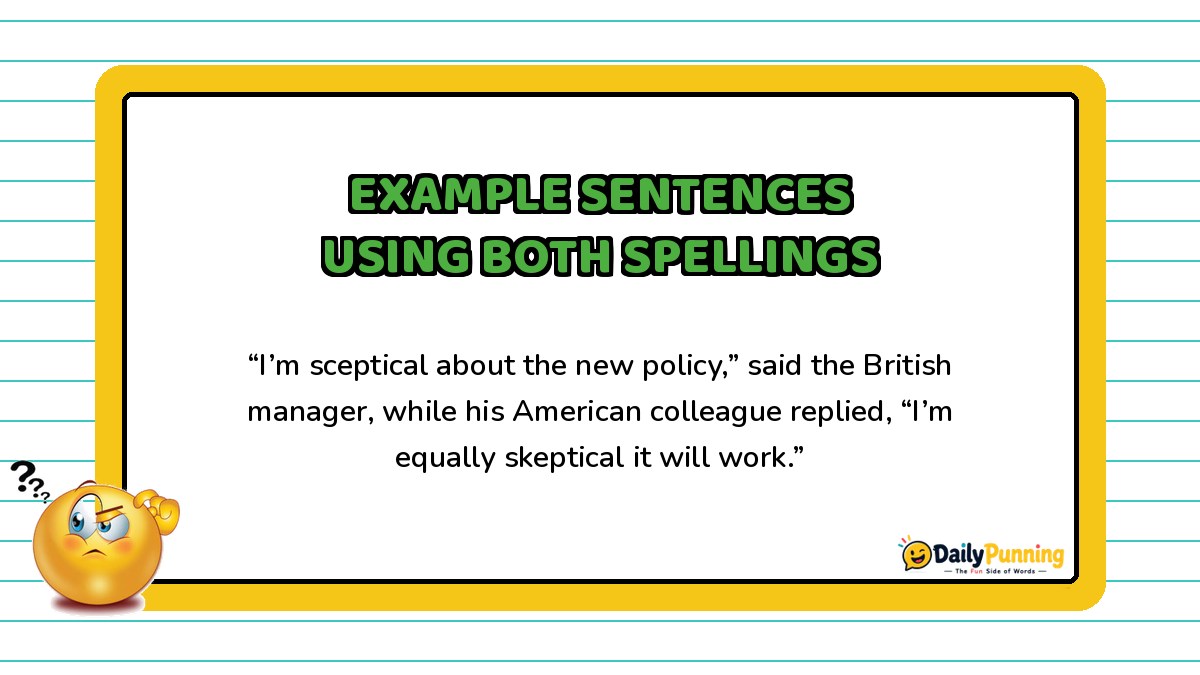
Seeing both versions used naturally in context can help solidify the sceptical or skeptical distinction:
American English examples:
- “She remained skeptical about the new sales pitch.” 💼
- “I’m a bit skeptical this plan will actually work.” 🤔
- “Many scientists were initially skeptical of the new theory.” 🔬
- “His skepticism made him question every claim in the report.” 📋
- “They looked at the offer skeptically before signing anything.” ✍️
British English examples:
6. “He was sceptical of the claims made in the article.” 📰
7. “Many scientists were initially sceptical of the theory.” 🔬
8. “Her scepticism was clear from her raised eyebrow.” 🤨
9. “The reviewer sceptically examined the new product.” 🔍
10. “I remain sceptical about these promises until I see results.” ⚖️
Notice how the meaning stays identical in every example — only the spelling convention changes based on regional context.
Sceptical or Skeptical in Professional & Academic Writing 💼🎓
Understanding how sceptical or skeptical applies in professional and academic contexts is particularly important, since consistency matters a great deal in formal writing:
- Academic papers: Universities and journals typically follow either American or British spelling conventions depending on their country of origin or target publication, so writers should check submission guidelines carefully
- Business communication: International companies often adopt one spelling convention company-wide to maintain consistency across all official documents, marketing materials, and internal communication
- Journalism: News organizations typically follow a specific style guide (such as AP Style in the US or Oxford/Guardian style in the UK) that clearly dictates which spelling of sceptical or skeptical to use
- Legal documents: Legal writing tends to be extremely precise, and using the wrong regional spelling consistently throughout a contract or legal brief could be seen as unprofessional, even though it wouldn’t affect the actual legal meaning
Why This Spelling Question Is So Commonly Searched 🔍
It might seem surprising that so many people search sceptical or skeptical online, but it makes complete sense once you consider a few factors:
- Both spellings are genuinely correct, unlike typical misspellings, which creates real uncertainty rather than a simple right-or-wrong answer
- Many people are only exposed to one regional spelling growing up and are surprised to discover the other version even exists
- Global communication through the internet means people are now regularly exposed to writing from multiple English-speaking regions, increasing exposure to both spellings
- Autocorrect tools sometimes flag the “wrong” version depending on language settings, creating confusion about which one is actually correct
- The word itself relates to questioning and doubt, which ironically makes people extra cautious about getting the spelling right
All of these factors combine to make sceptical or skeptical one of the most frequently searched English spelling comparisons, especially among students, professional writers, content creators, and non-native English speakers navigating international audiences.
Sceptical or Skeptical: A Quick Reference Summary 📋
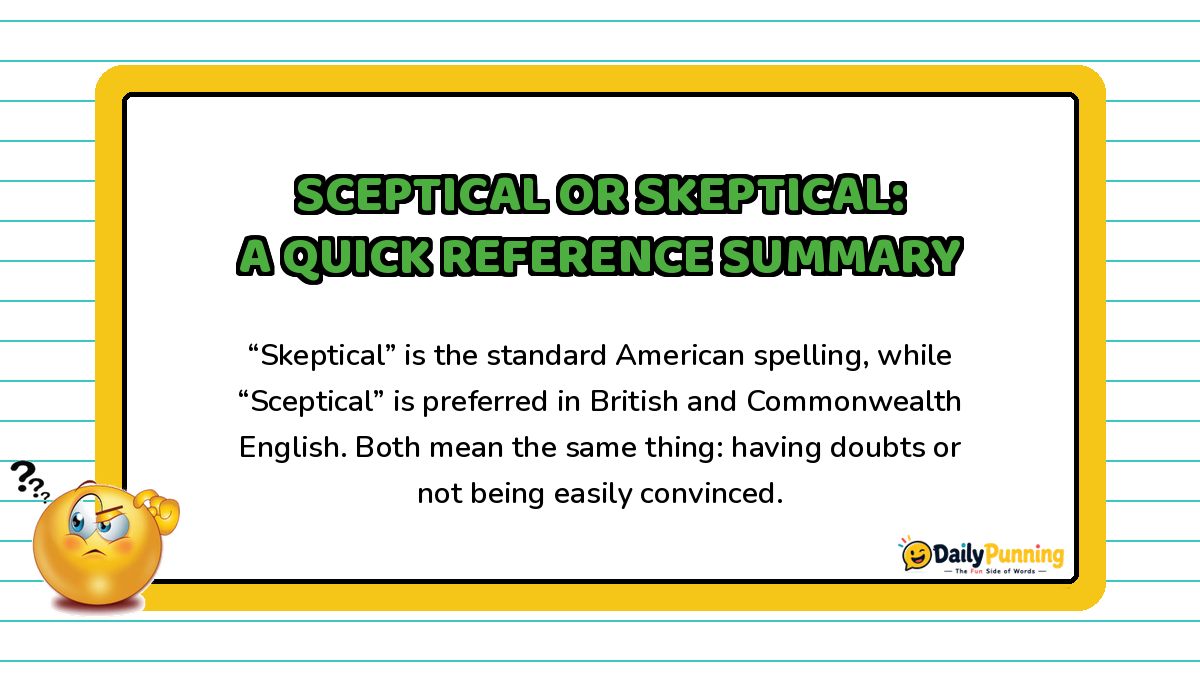
To wrap up the practical side of sceptical or skeptical, here’s a quick-reference summary you can bookmark for future use:
- Writing for American readers? → Use “skeptical,” “skeptic,” and “skepticism”
- Writing for British, Australian, or Commonwealth readers? → Use “sceptical,” “sceptic,” and “scepticism”
- Unsure of your audience? → Choose one version and remain fully consistent throughout your document
- Working within a company or publication? → Follow their established style guide
FAQs ❓
Is it sceptical or sceptical?
Both are correct; “sceptical” is standard American English, while “sceptical” is standard British, Australian, and Commonwealth English.
Which spelling should I use for a US audience?
Use “skeptical,” along with related forms like “skeptic” and “skepticism.”
Which spelling should I use for a UK audience?
Use “sceptical,” along with related forms like “sceptic” and “scepticism.”
Do “sceptical” and “sceptical” mean the same thing?
Yes, both spellings have identical meanings and are pronounced the same way; only the regional spelling convention differs.
Can I mix both spellings in one document?
It’s best to avoid this. Pick one spelling convention and remain consistent throughout your entire piece of writing for a professional, polished result.
Where does the word originally come from?
It traces back to the Ancient Greek word “skeptikos,” meaning “inquiring” or “reflective,” later passing through Latin and French before entering English.
Why does American English use “sk” instead of “sc”?
This traces back to American spelling reforms in the 18th and 19th centuries, largely influenced by Noah Webster’s efforts to simplify and distinguish American English spelling from British conventions.
Does Canadian English use sceptical or sceptical?
Canadian English often leans toward British spelling for this particular word, though Canadian English generally blends American and British conventions across different terms.
Conclusion 🏁
So, when it comes to sceptical or sceptical, there isn’t a single universally “correct” answer; both spellings are completely valid, and the right choice simply depends on your intended audience and regional English convention.
“Skeptical” belongs to American English, while “sceptical” belongs to British, Australian, and Commonwealth English, and both share the exact same meaning: having doubts and questioning something rather than accepting it blindly.
Now that you understand the origin, grammar, regional differences, and common mistakes surrounding sceptical or skeptical, you’ll be able to confidently choose and consistently use the correct spelling for your specific audience every single time. ✅🤔


